Blog

  • How to Calculate Labor Cost Percentage for Small Business: Step-by-Step Formula

    How to Calculate Labor Cost Percentage for Small Business: Step-by-Step Formula

    Your payroll reports might show steady hourly wages, yet your operating checking account mysteriously runs dry by month’s end. When I audited my first service business, I realized gross wages represent only two-thirds of actual workforce expenses. Mastering how to calculate labor cost percentage for small business operations reveals precisely what share of every revenue dollar keeps your team functioning.

    If that number climbs untracked, your business subsidizes inefficiency instead of producing profit.

    The Core Labor Cost Percentage Formula

    The Core Labor Cost Percentage Formula

    The calculation divides total burdened labor expenses by gross operational revenue across identical accounting windows:

    $$\text{Labor Cost Percentage} = \left(\frac{\text{Total Labor Cost}}{\text{Total Revenue}}\right) \times 100$$

    Both figures must stem from the identical calendar window. Mismatched accrual dates produce deceptive ratios.

    Step 1: Quantify Fully Burdened Labor Costs (Avoid the Phantom Payroll Trap)

    Step 1 Quantify Fully Burdened Labor Costs (Avoid the Phantom Payroll Trap)

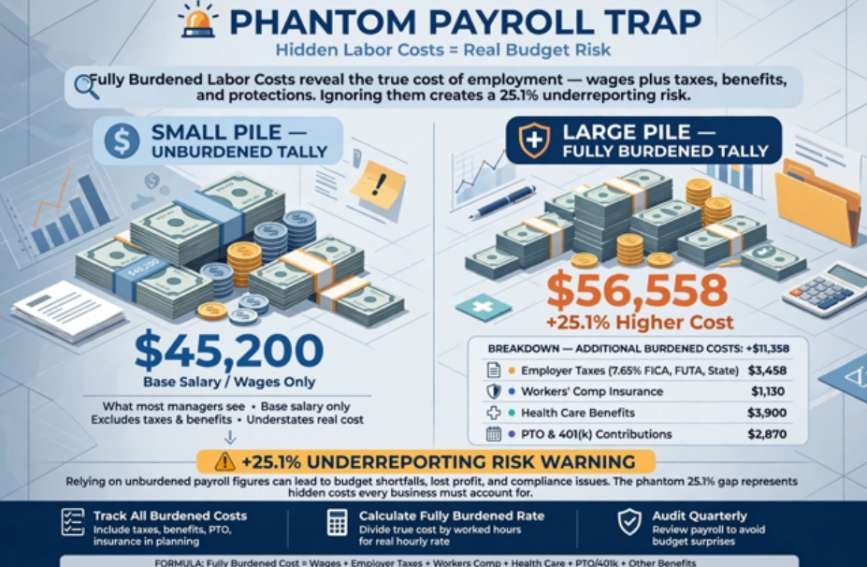
    The most damaging mistake I see operators make involves tallying hourly wages alone. Federal and state mandates, benefits, and insurance create an expense layer known as the labor burden.

    According to data compiled by the U.S. Bureau of Labor Statistics, non-wage benefits and statutory contributions account for roughly 30% of total employer compensation costs across private industry. Ignoring these items causes the “Phantom Payroll Trap”—an artificial margin that blinds you to operational losses.

    Your total labor figure must encompass all compensation commitments defined under IRS Publication 15:

    • Direct Compensation: Base wages, salaried payroll, production bonuses, commissions, tips paid by the house, and overtime premiums.
    • Statutory Employer Contributions: Employer-paid FICA (6.2% Social Security, 1.45% Medicare), federal unemployment tax (FUTA), and state unemployment insurance (SUTA).
    • Mandatory and Discretionary Benefits: Workers’ compensation insurance premiums, employer-paid medical/dental plans, and retirement match contributions.
    • Compensated Absence Accruals: Paid time off, holiday pay, and accrued bereavement or sick leave.
    • Owner-Operator Market Salary: If you manage daily tasks without a scheduled payroll draw, include your replacement market wage. Free owner labor masks operational insolvency.

    Burdened vs. Unburdened Labor Expense Breakdown

    The table below illustrates how true payroll burden expands total labor overhead for an eight-person staff:

    Cost Component Unburdened Tally True Fully Burdened Tally Notes on Variance
    Gross Wages & Salaries $42,000 $42,000 Base hourly and exempt payroll
    Overtime Premiums $3,200 $3,200 Time-and-a-half allocations
    Employer Payroll Taxes $0 (omitted) $3,458 FICA, FUTA, and SUTA obligations
    Workers’ Comp & Health Care $0 (omitted) $5,800 Premiums allocated per period
    PTO Accruals & 401(k) Match $0 (omitted) $2,100 Earned leave plus company match
    Total Labor Cost Figure $45,200 $56,558 +25.1% underreporting risk

    Calculating against $45,200 yields false confidence. You must run ratios against $56,558.
    Step 2: Establish Matched Gross Revenue

    Gross revenue comprises total top-line sales receipts generated during the corresponding calendar cycle. Pull this number straight from your point-of-sale or accounting software before subtracting operating expenses, inventory costs, or debt service.

    If calculating for an April 1–April 30 payroll window, match it against April 1–April 30 gross billings. Mixing two-week payroll cadences with monthly sales aggregates distorts your percentage by up to 14%.

    The U.S. Small Business Administration highlights that aligning accounting periods ensures accurate operational forecasting.

    Businesses operating across multiple locations should also maintain consistent scheduling practices and review a fair workweek compliance checklist for multi-unit businesses to keep labor planning organized.

    Step 3: Run the Calculation with a Real-World Scenario

    Step 3 Run the Calculation with a Real-World Scenario

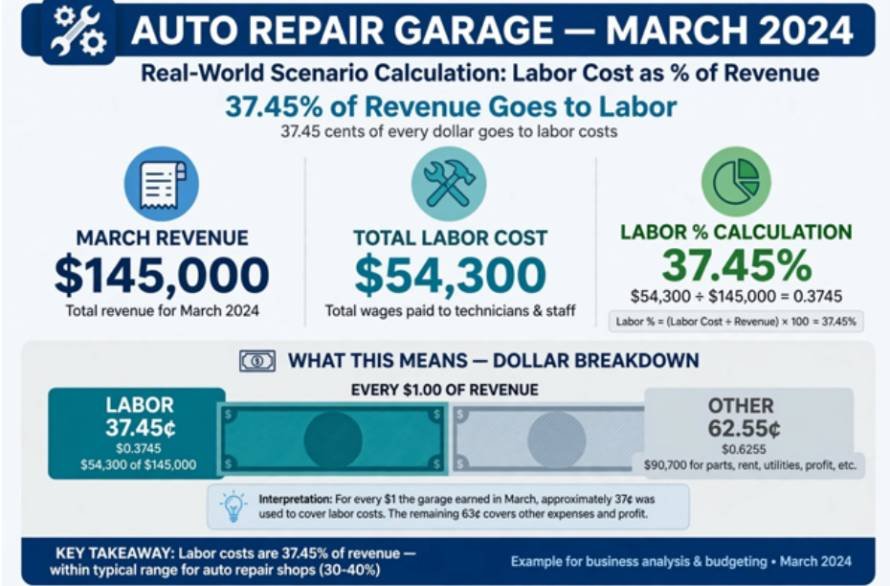
    Let us evaluate an independent auto repair garage assessing its financial performance for March:

    • Gross Sales (Total Revenue): $145,000
    • Hourly Tech & Service Writer Wages: $36,000
    • Employer Taxes, Workers’ Comp, & Benefits: $11,800
    • Owner-Operator Working Wage: $6,500
    • Total Fully Burdened Labor: $54,300

    $$\text{Labor Cost Percentage} = \left(\frac{\$54,300}{\$145,000}\right) \times 100 = 37.45\%$$

    Labor consumes 37.45 cents of every dollar entering the register.

    Industry Benchmarks: What Does a Healthy Percentage Look Like?

    Industry Benchmarks What Does a Healthy Percentage Look Like

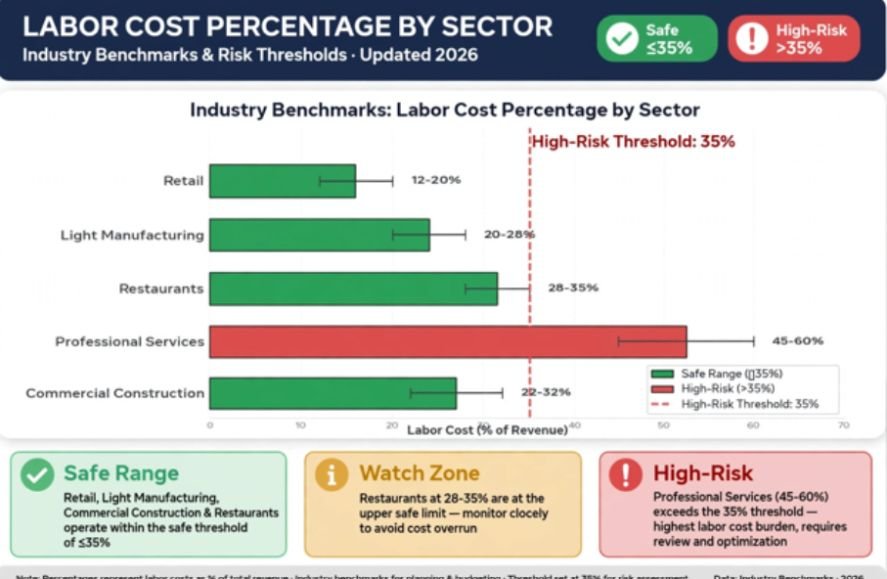
    Safe payroll thresholds vary widely by sector. Research from hospitality institutions like the Cornell University School of Hotel Administration demonstrates that customer-facing hospitality models require elevated staffing levels, whereas capital-heavy sectors prioritize asset utilization over headcount.

    Industry Vertical Typical Safe Range High-Risk Margin Threshold Primary Driver
    Retail & E-commerce 12% – 20% > 25% Automated checkout & self-service merchandising
    Light Manufacturing 20% – 28% > 32% Capital equipment vs. assembly-line headcount
    Restaurants & Hospitality 28% – 35% > 38% Shift prep, table service, and kitchen staffing
    Professional Services 45% – 60% > 65% Billable talent constitutes the inventory sold
    Commercial Construction 22% – 32% > 36% Project-based craft trades and union rates

    Four Strategic Levers to Optimize Your Labor Ratio

    When margins tighten, knee-jerk layoffs harm company morale. Preventing burnout among customer-facing staff is another important part of maintaining productivity without simply increasing headcount. Protect profits with operational adjustments first:

    Protect profits with operational adjustments first:

    1. Schedule to Sales Demand Curves: Map historical revenue velocity by hourly intervals. Stagger shift starts to match real foot traffic rather than staffing arbitrary eight-hour blocks.
    2. Track Labor Cost Per Unit Produced: In service or manufacturing workflows, calculate labor cost per repair order, meal served, or pallet packed. Monitoring workload and team efficiency can also help identify issues that contribute to peer conflict among frontline workers. Team efficiency becomes visible immediately.
    3. Automate Administrative Overhead: Eliminate repetitive clerical tasks. Route appointment scheduling, standard billing queries, and timesheet logging through digital software.
    4. Tie Incentive Pay to Gross Margin: Swap discretionary annual perks for performance-based bonuses funded exclusively when team labor metrics remain below target.

    Frequently Asked Questions

    1. Should contract 1099 labor be included in the formula?

    Yes, add 1099 payments when contractors perform operational production tasks directly tied to core revenue generation.

    2. How often should small businesses calculate labor cost percentages?

    Calculate your percentage weekly for hourly operations like restaurants, and monthly for salaried professional firms.

    3. Does overtime pay inflate this percentage permanently?

    Overtime raises the ratio immediately because premium pay increases labor expenses without producing proportional revenue gains.

    4. Why do professional service firms sustain higher labor cost percentages?

    Consulting, accounting, and legal practices sell intellectual labor rather than raw physical goods, creating minimal material expenses.

    Stop Bleeding Cash: Your Weekly Action Blueprint

    Operating without tracking your labor cost percentage resembles driving cross-country with a broken fuel gauge. Download your latest monthly payroll summary, pull your gross revenue report, apply the fully burdened formula, and plot your number against your industry’s safe threshold. If your labor sits five points above average, restructure shift scheduling and trim non-productive overtime this week.

  • How to Manage Workload When Short-Staffed Without Losing Control

    How to Manage Workload When Short-Staffed Without Losing Control

    A staffing shortage rarely becomes a serious problem on the first day. The real trouble starts when unfinished work quietly piles up, reliable employees begin absorbing extra responsibilities, and overtime slowly becomes part of the normal routine.

    When I think about how to manage workload when short-staffed, I do not start by asking employees to move faster. I start by deciding what work deserves limited time, which deadlines can move, where capacity still exists, and what should be paused completely. In a US workplace, that kind of prioritization can help managers protect service levels without pushing the remaining team toward burnout.

    The goal is not to preserve every task at any cost. It is to keep high-impact work moving, make trade-offs visible, and create enough breathing room for employees to perform consistently until staffing levels improve.

    What Should You Prioritize First When Your Team Is Short-Staffed?

    I start by separating work into what must happen now, what should happen soon, and what can wait.

    Customer commitments, safety requirements, payroll, compliance obligations, revenue-generating work, and contractual deadlines usually belong near the top. Optional internal reporting, lower-value meetings, or projects with little immediate business impact may need to move.

    A simple priority matrix can help, but the important part is being willing to act on it. If a task is neither urgent nor important, I would rather postpone or eliminate it than force an already overloaded employee to complete it after hours.

    In some cases, managers must consciously allow minor deadlines to slide so that critical work succeeds. I do not see that as poor management. I see it as making a deliberate trade-off when resources are limited.

    How Do You Measure Your Team’s Real Capacity?

    How Do You Measure Your Teams Real Capacity

    Before redistributing workload, I want to know what employees are already carrying.

    Headcount alone can be misleading. One person may have five relatively simple tasks while another has two projects that consume nearly every available hour. Meetings, client calls, administrative work, planned leave, specialized duties, and project complexity all affect team capacity.

    I also look for hidden overtime. If employees are regularly answering emails late at night, finishing reports after dinner, or skipping lunch to keep projects moving, the official schedule is not showing the real workload.

    Making those extra hours visible gives managers a more accurate picture of resource allocation and helps prevent employee burnout.

    How Can You Redistribute Work Without Overloading Top Performers?

    Fair workload distribution is not about dividing every task equally.

    A clear approach to how to manage team members with conflicting priorities can also help managers decide which responsibilities should take precedence when employees are balancing multiple demands.

    I consider skills, current commitments, experience, deadlines, and available capacity before assigning additional responsibilities. Sometimes a senior employee should own the most sensitive part of a project, while a less experienced employee handles documentation, coordination, or follow-up.

    However, I avoid sending every urgent assignment to the strongest performer simply because I trust that person to deliver. Reliability should not become a penalty.

    Cross-training helps here. When more than one employee understands a critical process, managers gain more flexibility and reduce single points of failure. I would also look at slower departments and temporarily redeploy employees who have relevant skills before assuming external hiring is the only answer.

    Should You Renegotiate Deadlines When Staffing Drops?

    Absolutely, when reduced capacity makes the original timeline unrealistic.

    One of the most important parts of how to manage workload when short-staffed is managing expectations upward. I would communicate early with company leadership, clients, or internal stakeholders instead of waiting until a deadline is missed.

    If the team has lost 25% of its available capacity, stakeholders may need to choose between a later deadline, narrower scope, or additional resources.

    Those choices should happen openly. Employees should not be expected to quietly absorb every staffing gap through overtime.

    How Can Managers Protect Employees From Burnout?

    How Can Managers Protect Employees From Burnout?

    Short staffing becomes dangerous when temporary extra effort turns into the new normal.

    I watch for increasing errors, missed deadlines, declining quality, absenteeism, reduced engagement, skipped breaks, and employees consistently working outside normal business hours.

    I also encourage people to take their full lunch and rest breaks. Mental fatigue does not disappear because a department is understaffed. In many cases, exhausted employees become slower and make more mistakes, creating additional work.

    Where the role allows it, I also give employees flexibility over how and when they complete their core responsibilities. Greater autonomy can reduce some of the psychological pressure that comes with a heavy employee workload.

    Most importantly, employees need permission to raise workload conflicts early. If someone tells me that two projects cannot realistically be finished by Friday, I want that information before the deadline, not after it.

    Why Should Managers Explain What Is Happening?

    Uncertainty can make a staffing shortage feel worse.

    I believe managers should explain why the shortage happened when appropriate, what the organization is doing to address it, how priorities are changing, and when additional support may arrive if there is a realistic timeline.

    I would rather over-communicate than leave employees wondering whether an extreme workload is temporary or permanent.

    Clear communication can also protect employee morale. Managers can strengthen this approach by learning how to improve communication between managers and employees so that workload changes, expectations, and staffing decisions are communicated clearly.

    People are more likely to understand difficult short-term adjustments when they can see that leadership recognizes the problem and is actively working on a solution.

    When Should You Use Automation, Contractors, or Temporary Staff?

    There is a point where internal workload management is no longer enough.

    If employees have reached reasonable capacity, I would consider temporary agency workers, freelancers, independent contractors, outsourcing, or interdepartmental support.

    Automation can also help reduce repetitive administrative work such as scheduling, basic data entry, routine reporting, reminders, or simple approval processes.

    However, I would only introduce technology when it genuinely saves time. A complicated new system can create more work during a period when the team already lacks capacity.

    What Mistakes Make Short Staffing Worse?

    What Mistakes Make Short Staffing Worse

    The biggest mistake is assuming that fewer employees can permanently maintain the same output.

    Another common mistake is adding responsibilities without removing anything else. Eventually, the workload exceeds the available hours.

    Applying lean principles to shift work and workforce output can help managers identify unnecessary steps, reduce wasted effort, and improve how limited workforce capacity is used.

    I would also avoid normalizing excessive overtime, skipping breaks, relying constantly on top performers, hiding staffing problems from clients or leadership, and treating every capacity concern as a motivation issue.

    Managers need to recognize when the problem is not employee productivity but simply insufficient resources.

    How Do You Fix the Problem Long Term?

    Short-term prioritization keeps work moving, but recurring staffing gaps require workforce planning.

    I would review turnover trends, hiring timelines, seasonal demand, recurring overtime, absenteeism, critical skill gaps, and workload forecasts. I would also document important processes so that essential knowledge does not disappear when someone leaves.

    Retention deserves attention as well. If employees repeatedly carry excessive workloads because vacancies stay open too long, the company risks creating a cycle where understaffing causes burnout and burnout causes more turnover.

    Frequently Asked Questions 

    1. How do you prioritize tasks when understaffed?

    I prioritize customer commitments, safety, compliance, revenue-critical work, and fixed deadlines first. Lower-impact work should be delayed, reduced, delegated, automated, or temporarily removed.

    2. How do you distribute workload fairly?

    Fair workload distribution should consider capacity, skills, experience, task complexity, and deadlines rather than simply giving every employee the same number of assignments.

    3. How do you keep employees motivated when short-staffed?

    Communicate openly, explain changing priorities, recognize additional effort, protect breaks, offer flexibility where possible, and show employees what management is doing to resolve the staffing shortage.

    4. When should a business bring in temporary help?

    Temporary staffing makes sense when the shortage is likely to continue, customer commitments are at risk, or permanent employees have already reached a reasonable workload.

    5. Can short staffing increase employee turnover?

    It can. Persistent overtime, heavy workloads, poor communication, and limited recovery time may contribute to burnout and lower employee morale, which can make retention more difficult.

    Conclusion

    When I think about managing workload when short-staffed, I do not ask how fewer people can somehow complete everything. I ask what work matters most, what can wait, how much capacity the team truly has, and what support employees need to stay productive without burning out.

    The strongest managers make difficult trade-offs visible. They adjust deadlines, drop low-value work, monitor hidden overtime, protect breaks, cross-train employees, communicate openly, and bring in temporary resources when necessary. Most importantly, they treat short staffing as a capacity problem that needs to be solved, not as a permanent excuse to overload the people who stayed.

  • How to Manage a Team During Organizational Change Without Losing Your Team

    How to Manage a Team During Organizational Change Without Losing Your Team

    Organizational change rarely affects only policies, technology, or reporting structures. It affects people who may suddenly question their responsibilities, workload, job security, or ability to succeed under a new system.

    When I consider how to manage a team during organizational change, I see the manager as the bridge between executive strategy and everyday execution. Senior leaders may decide where the organization is going, but direct managers often have to explain what that decision means on Monday morning. That requires transparent communication, empathy, employee involvement, realistic priorities, training, and clear accountability.

    The goal is not to eliminate every concern. It is to give employees enough clarity, support, and confidence to keep moving forward.

    How Should Managers Communicate Organizational Change to Employees?

    I communicate early and continue communicating throughout the transition.

    One announcement is rarely enough. Employees often develop more questions after they have had time to understand how the change affects their work. If managers become silent after the initial announcement, rumors and assumptions can quickly fill the gap.

    I explain what I know, what is still being decided, and when employees can reasonably expect another update. I would rather tell my team that I do not have an answer yet than offer information that may later prove incorrect.

    Consistent change communication builds trust because employees know they will not be left guessing.

    Explain Why the Change Is Happening

    Employees need more than instructions about what will change.

    I explain why the organization is making the transition and connect it to larger business priorities, such as customer needs, growth, cost control, efficiency, new technology, competition, or long-term company strategy.

    Understanding the purpose does not guarantee that every employee will support the change immediately, but it gives the disruption context. People can usually respond more constructively when they understand the business reason behind the decision.

    Tell Employees What Is Changing and What Is Staying the Same

    Tell Employees What Is Changing and What Is Staying the Same

    During organizational change, employees may assume that everything is uncertain.

    I reduce that uncertainty by clearly separating what is changing from what is not.

    A restructuring might change reporting relationships while leaving customer responsibilities unchanged. A technology rollout may alter workflows without changing performance standards. A merger could introduce new systems while existing deadlines remain in place.

    Employees should understand their responsibilities, immediate priorities, decision-making authority, and expectations during the transition.

    Providing stability where stability exists helps employees focus on work instead of trying to predict every possible outcome.

    How Can Managers Involve Employees in Organizational Change?

    Employee involvement does not mean every organizational decision becomes a vote.

    Instead, I separate decisions that leadership has already finalized from implementation decisions where employees can contribute.

    A company may have already selected a new software platform, for example, but employees could provide input on training schedules, workflow design, rollout timing, reporting requirements, or recurring problems that need attention.

    Inviting feedback gives employees a greater sense of ownership and can uncover practical problems leadership may not have anticipated.

    It also strengthens employee buy-in because employees participate in shaping how change happens rather than simply having change happen to them.

    How Should Managers Handle Employees Who Resist Change?

    I do not automatically interpret resistance as negativity or poor attitude.

    Resistance can come from uncertainty, fear of failure, heavier workloads, skill gaps, loss of authority, concern about job security, or legitimate doubts about how a new process will work.

    I first try to understand the reason.

    An employee who worries about learning unfamiliar software needs a different response from someone who understands the change but repeatedly refuses to follow the new process.

    Listening helps me determine whether the right response is additional information, training, coaching, workload adjustments, employee involvement, or firmer accountability.

    Giving employees room to work through new responsibilities can also help managers manage employees without micromanaging, particularly when the goal is to provide support without controlling every step.

    Strong change leadership combines empathy with expectations.

    How Can Managers Keep Employees Productive During Organizational Change?

    How Can Managers Keep Employees Productive During Organizational Change

    Change creates new meetings, training sessions, questions, documentation, and transition work, but the normal workload often does not disappear automatically.

    That is where managers can accidentally overload their teams.

    I review current capacity and decide what remains urgent, what can be delayed, and what should be reassigned.

    When several demands compete for attention, managers also need to manage competing priorities so employees can focus their time and effort on the work that matters most.

    If employees receive major new responsibilities, I look for work that can temporarily move down the priority list.

    Workload management matters because sustained overload can contribute to change fatigue, mistakes, declining morale, and employee disengagement.

    Employees need to know what matters most now rather than hearing that everything remains a priority.

    Managers can also establish clear expectations for employees to understand what is required of them as priorities and responsibilities change.

    Why Are Training and Coaching Important During Organizational Change?

    Employees may resist a new process because they are uncertain whether they can perform successfully within it.

    Training can remove some of that uncertainty.

    I make training practical and connected to the employee’s actual responsibilities. Instead of relying only on a presentation, I provide opportunities to practice new workflows, ask questions, review examples, and receive feedback.

    When appropriate, written procedures, job aids, demonstrations, peer support, and follow-up coaching can reinforce formal training.

    I also make sure employees know where to get help after training ends. Upskilling works best when employees have continued support while they apply new knowledge in real situations.

    How Can Managers Use Empathy Without Losing Accountability?

    Empathy and accountability should work together rather than compete.

    I acknowledge that organizational change can be stressful, especially when it affects roles, routines, relationships, or long-term career plans.

    Team meetings are useful, but I also make time for one-on-one check-ins because some employees will not discuss concerns publicly.

    Those conversations help me understand individual challenges without making assumptions.

    At the same time, employees still need to meet reasonable expectations. I clarify responsibilities, deadlines, decision authority, and escalation procedures so that uncertainty does not become an excuse for unclear ownership.

    Why Should Managers Celebrate Small Wins During Change?

    Why Should Managers Celebrate Small Wins During Change

    Major transformations can feel overwhelming when employees only see a distant final objective.

    I break the transition into smaller milestones where possible and recognize meaningful progress along the way.

    A successful training milestone, a smooth department rollout, fewer process errors, faster adoption, positive customer feedback, or an employee helping coworkers adjust can all demonstrate that progress is happening.

    Recognition helps reinforce the behaviors the organization needs and can strengthen team morale during a demanding transition.

    Small wins also give employees evidence that their effort is producing results.

    How Do You Measure Whether Organizational Change Is Working?

    Completing a rollout does not automatically mean the change succeeded.

    I look at whether employees are actually adopting the new process and whether it is producing the intended outcome.

    Depending on the change, I may review productivity, errors, customer impact, missed deadlines, employee feedback, training completion, process adoption, rework, or other relevant performance measures.

    I also continue asking employees what is working and where friction remains.

    That feedback helps managers correct implementation problems before they become permanent operating habits.

    Frequently Asked Questions 

    1. How can managers reduce employee anxiety during organizational change?

    Managers can reduce unnecessary anxiety by providing timely information, clarifying what is known and unknown, explaining how individual roles may be affected, maintaining regular communication, and giving employees opportunities to discuss concerns privately.

    2. How often should managers communicate during organizational change?

    I communicate whenever meaningful information becomes available while also maintaining predictable updates during longer transitions. Even when there is no final decision, employees benefit from knowing that an issue remains under review rather than receiving prolonged silence.

    3. What should a manager do when employees do not support organizational change?

    I first identify why employees are struggling with the transition. Resistance may come from uncertainty, workload concerns, insufficient training, disagreement, or fear about personal consequences. Understanding the cause helps determine whether communication, coaching, training, involvement, or stronger accountability is appropriate.

    4. How do you keep team morale high during organizational change?

    Clear communication, realistic workloads, employee involvement, private check-ins, useful training, recognition, and visible progress can help protect morale. Managers should also watch for change fatigue when employees are managing multiple transitions simultaneously.

    5. What is the most important part of managing a team through change?

    The most important part is maintaining trust while giving employees enough clarity to act. Understanding how to manage a team during organizational change requires managers to connect business strategy with practical expectations, ongoing support, and consistent communication.

    How to Manage a Team During Organizational Change Successfully

    Learning how to manage a team during organizational change means understanding that people need both direction and support.

    I communicate continuously, explain the purpose behind the change, clarify what remains stable, involve employees where possible, provide training, adjust workloads, listen to concerns, reinforce accountability, and recognize progress.

    Most importantly, I avoid assuming that the first announcement completes the manager’s job. Change management continues as employees begin working differently, encounter problems, build confidence, and develop new routines.

    Managers who stay visible and consistent can reduce uncertainty without pretending it does not exist.

  • How to Improve Employee Productivity in Shift Work Without Burning People Out

    How to Improve Employee Productivity in Shift Work Without Burning People Out

    Nearly 30% of the American workforce works outside a regular daytime schedule, according to NIOSH. That matters because productivity on a night, rotating, or extended shift is shaped by something managers cannot coach away: human biology. Fatigue slows reaction time, weakens concentration, limits short-term memory, and impairs judgment. 

    That is why learning how to improve employee productivity in shift work starts with better schedules, recovery time, workload design, and communication—not simply asking people to work harder. The aim is to build shifts in which employees can stay alert, understand priorities, recover properly, and hand work off without unnecessary friction.

    Productivity Problems Often Begin Before the Shift Starts

    A worker can arrive on time and still begin at a disadvantage. Night work conflicts with the body’s circadian rhythm, which regulates sleep and wakefulness.

    OSHA notes that long, irregular, and extended shifts can disrupt this cycle and contribute to fatigue and reduced concentration. CDC likewise reports that work-related fatigue can reduce attention, short-term memory, reaction speed, and judgment.

    So low output may not be a motivation problem. It may be the predictable result of back-to-back shifts, inconsistent schedules, excessive overtime, understaffing, or difficult transitions between nights and mornings.

    Build Schedules That Protect Alertness

    Build Schedules That Protect Alertness

    Make Shifts Predictable

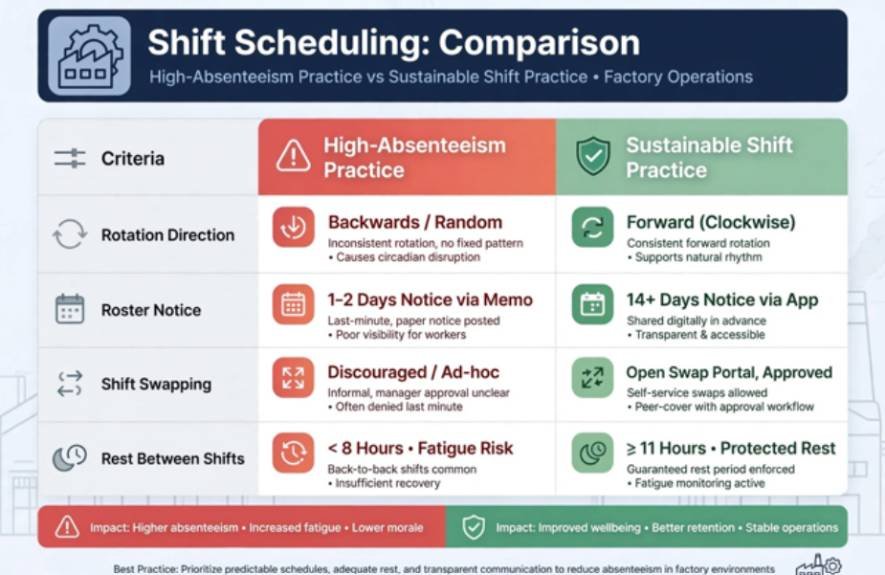
    Publish schedules as far in advance as operations reasonably allow. Predictability helps employees plan sleep, transportation, child care, appointments, and other responsibilities.

    A University of Chicago randomized scheduling experiment with Gap stores found that more stable scheduling increased median sales by 7% and labor productivity by 5%. The exact gain will vary by workplace, but schedule stability can have measurable business value.

    Predictability also reduces the mental load created when employees must constantly rearrange their lives around last-minute staffing changes.

    Rotate Forward and Protect Recovery Time

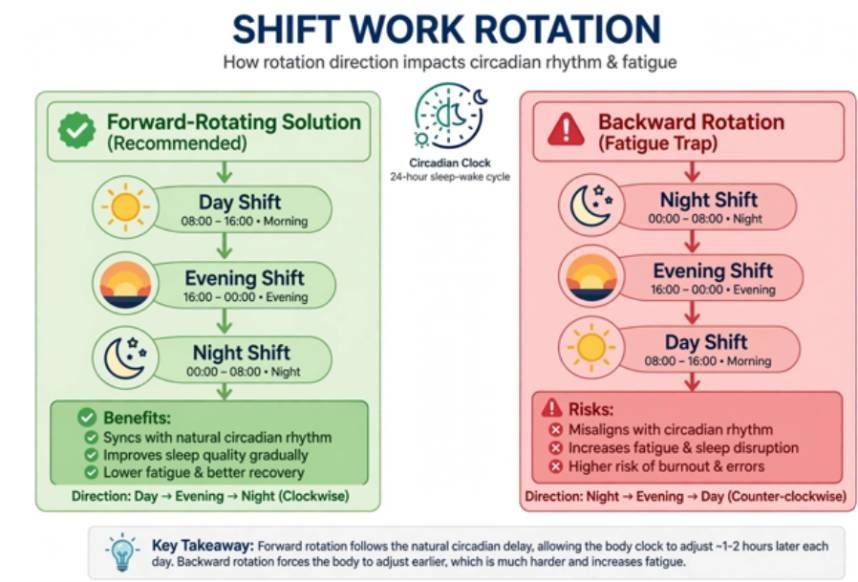
    When rotating shifts are necessary, forward rotation—day to evening to night—is generally preferred to backward rotation.

    The National Safety Council recommends forward rotation along with regular schedules, adequate recovery time, frequent breaks, and opportunities for employees to have a voice in scheduling. 

    Avoid rapid “quick returns,” such as closing late and returning early. More time between shifts gives workers a better chance to sleep and recover.

    Give Employees Controlled Flexibility

    Shift bidding and approved swaps can reduce call-outs when they operate within clear guardrails: required skills, overtime limits, minimum rest periods, and coverage rules.

    Managers should also consider how to manage shift swap productivity loss so that flexibility does not unintentionally create coverage gaps or disrupt team performance.

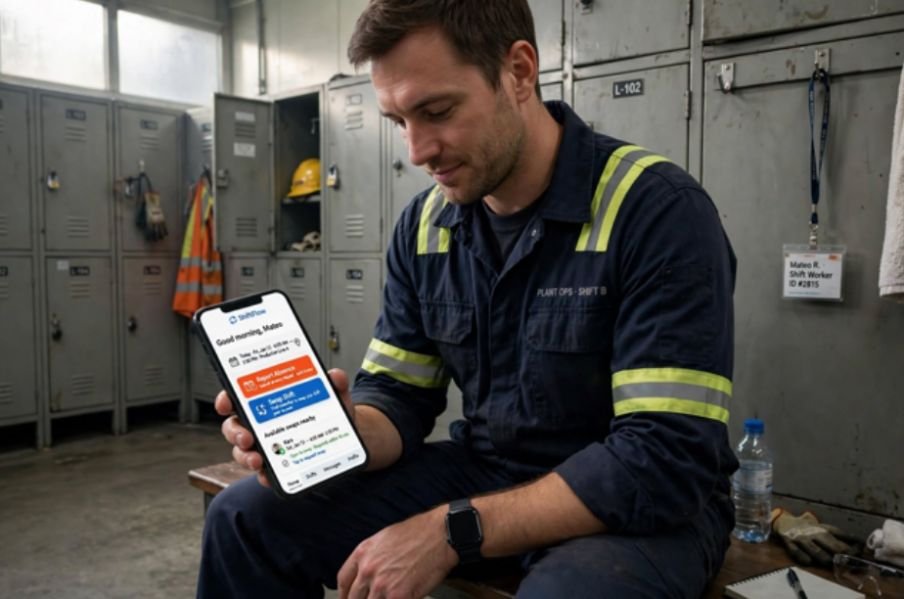
    Modern workforce management software can centralize availability, time-off requests, open shifts, and approvals. The technology matters less than the process: employees should know where schedules live and how changes are approved.

    Treat Fatigue as an Operational Risk

    Fatigue should be managed like any other factor that can reduce quality, speed, or safety.

    OSHA advises employers to examine staffing, workload, work hours, absences, and opportunities for rest. A practical fatigue plan can include scheduled breaks, limits on excessive overtime, adequate staffing during peak periods, and a process for employees to report when fatigue could create a safety problem.

    Breaks should match the work. A warehouse picker, emergency nurse, machine operator, and hotel employee do not experience the same physical or mental load.

    Instead of forcing one productivity technique across every role, managers should consider task intensity, repetition, physical demands, environmental conditions, and the consequences of an error.

    Design Work Around Energy, Not Just Clock Time

    Managers often distribute tasks according to deadlines alone. A better system also considers alertness.

    Place safety-sensitive, detail-heavy, or cognitively demanding work where staffing and alertness are strongest. Use lower-energy periods for routine checks, replenishment, cleanup, documentation, or other work that can be performed safely with less sustained concentration.

    The National Heart, Lung, and Blood Institute recommends bright light at work for shift workers and limiting caffeine to the first part of a shift so it is less likely to interfere with later sleep.

    Light, temperature, noise, workload, and repetitive tasks can all influence how difficult it is to remain alert.

    Fix Handoffs and Communication

    Fix Handoffs and Communication

    Shift work creates a problem traditional office teams face less often: the person who starts a task may not finish it.

    Poor handoffs create duplicated work, missed maintenance, unresolved customer issues, inventory mistakes, and repeated questions.

    Use one primary channel for schedule changes, shift notes, time-off requests, and operational updates rather than scattering information across texts, paper boards, chats, and email.

    For teams working away from desks, applying deskless worker productivity strategies can also make these updates easier to access and act on during the shift.

    A useful handoff should answer four questions: What was completed? What remains open? What changed during the shift? What requires immediate attention next?

    Keeping the format short matters. A perfect handoff process that takes 20 minutes will eventually be ignored.

    Measure Productivity Without Rewarding Exhaustion

    Output per hour matters, but it can mislead if managers ignore errors, safety incidents, absenteeism, and overtime. A team processing more orders while generating more rework is not necessarily becoming more productive.

    Measure What to Watch
    Output per labor hour Throughput by individual shift
    Error or rework rate Quality deterioration late in shifts
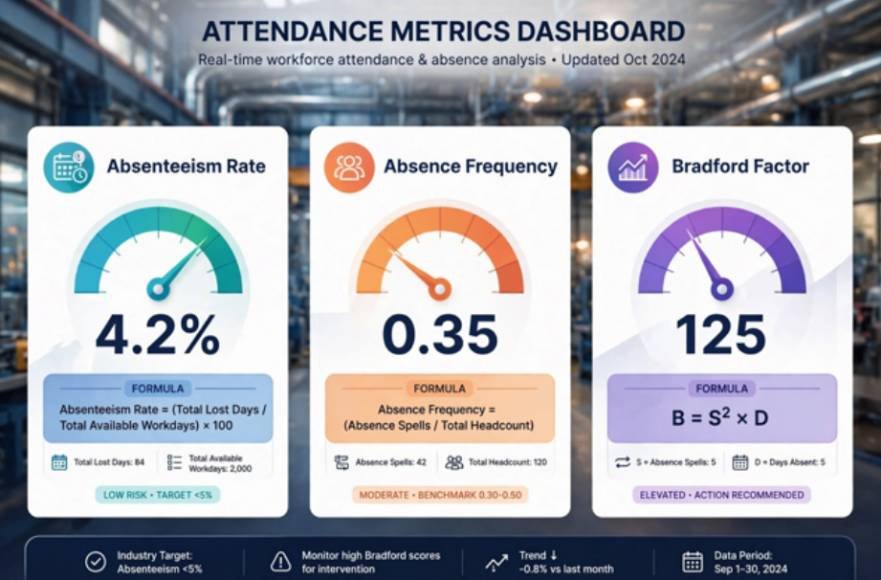
    Absence or call-out rate Problems following particular rotations
    Overtime hours Chronic staffing or workload gaps
    Safety and near misses Fatigue-related patterns
    Last-minute schedule changes Loss of schedule predictability

    Look at these measures by shift rather than only by week, department, or location. Otherwise, strong daytime performance can conceal recurring overnight problems.

    Managers should also consider overtime productivity decline studies when evaluating whether higher output is actually coming from productive work or simply from adding more hours.

    Run a 30-Day Shift Productivity Test

    Run a 30-Day Shift Productivity Test

    Managers do not need to redesign the entire operation at once. Test one meaningful change for 30 days.

    Record baseline output, errors, call-outs, overtime, and near misses by shift. Then select one intervention: publish schedules earlier, reduce quick returns, add a structured break, improve handoffs, or introduce controlled shift swapping.

    After four weeks, compare the same measures and ask employees one simple question: “What made it easier or harder to do good work on this shift?”

    Keep changes that improve both output and reliability.

    If throughput rises while errors, injuries, absenteeism, or unsustainable overtime also increase, the change has not created a genuine productivity improvement.

    Where Common Shift Productivity Advice Fails

    No single shift pattern works everywhere.

    Hospitals, logistics operations, manufacturers, emergency services, hospitality companies, and utilities may require continuous coverage. Some employees also prefer longer shifts because they reduce commuting days or create longer blocks of time away from work.

    Research guidance from the American Academy of Sleep Medicine and the Sleep Research Society emphasizes that shift-duration decisions should account for factors such as workload, time of day, recovery opportunities, commute demands, task risk, and operational requirements.

    The right system balances productivity with recovery, reliability, employee preferences, and the actual risks of the work.

    Frequently Asked Questions

    1. What is the fastest way to improve shift worker productivity?

    Start with schedule stability. Reduce last-minute changes, excessive overtime, and short recovery periods, then track output, errors, absenteeism, and employee feedback by shift.

    2. Are 12-hour shifts less productive than 8-hour shifts?

    Not always. Results depend on workload, breaks, time of day, consecutive shifts, recovery time, and job risk. Longer shifts generally require closer fatigue monitoring.

    3. Do employee shift swaps improve productivity?

    They can when swaps use skills requirements, overtime checks, minimum rest rules, and coverage controls. Flexibility should not create understaffing or excessive work hours.

    4. How can managers improve night-shift performance?

    Use predictable schedules, sufficient recovery, planned breaks, clear handoffs, appropriate lighting, sensible workload distribution, and a process for employees to report fatigue concerns.

    A Better Shift Starts With the System

    The most important lesson in how to improve employee productivity in shift work is that performance is built into the operating system long before anyone clocks in. Predictable schedules, sufficient recovery, smart task timing, clean handoffs, and employee input remove friction that motivation alone cannot solve.

    Start with one measurable change and track output, quality, attendance, and safety for a month. If employees can perform more consistently without accumulating more fatigue or errors, productivity is genuinely improving. The strongest shift is not the one that extracts the most effort; it is the one people can perform well repeatedly.

  • A Practical Approach to Resolving Employee Complaints

    A Practical Approach to Resolving Employee Complaints

    When an employee raises a complaint, the manager’s first reaction can shape everything that follows. I believe the best response is neither defensive nor dismissive. It is calm, respectful, and focused on understanding the facts. Employees need to know that speaking up will not damage their careers or relationships at work.

    Learning how to handle employee complaints effectively helps managers resolve individual concerns while strengthening trust across the organization. A reliable process also reduces misunderstandings, exposes recurring workplace problems, and ensures that serious allegations receive the attention they deserve.

    Why Employee Complaints Must Be Taken Seriously

    A complaint may involve workload, pay, favoritism, unsafe conditions, bullying, discrimination, harassment, scheduling, management behavior, or conflict between coworkers. Even when a concern initially appears minor, ignoring it may allow frustration to grow.

    Employees who feel unheard may become disengaged, take more absences, lose confidence in leadership, or leave the organization. Other team members may also stop reporting problems if they believe management will not respond fairly.

    Taking a complaint seriously does not mean automatically agreeing with the employee. It means giving the concern proper attention, gathering reliable information, and reaching a decision through a consistent process.

    How to Handle Employee Complaints Effectively Step by Step

    How to Handle Employee Complaints Effectively Step by Step

    1. Respond Promptly and Arrange a Private Conversation

    Acknowledge the concern as soon as possible. If an immediate conversation is not practical, arrange a private meeting and explain when it will happen. Delays can increase anxiety and create the impression that management is avoiding the issue.

    Choose a confidential setting where the employee can speak without interruptions. Thank the person for coming forward and avoid making assumptions before hearing the complete account.

    2. Listen Without Judging or Interrupting

    Allow the employee to describe the problem in their own words. Managers sometimes begin defending a decision, explaining another person’s intentions, or proposing solutions too early. These reactions can make the employee feel dismissed.

    Use open questions to establish what happened, when it happened, where it occurred, who was involved, and whether anyone witnessed it. Ask whether the employee has messages, documents, photographs, schedules, or other relevant information.

    The purpose of the first conversation is to understand the concern, not determine who is right.

    3. Clarify the Desired Outcome

    Ask what the employee hopes will happen. The person may want an explanation, an apology, a corrected payment, a schedule change, mediation, protection from certain behavior, or a formal investigation.

    The requested outcome may not always be possible or appropriate. However, understanding it can reveal what is driving the complaint and help management consider a proportionate response. Never promise a specific result before reviewing the facts.

    4. Document the Essential Details

    Create an accurate written record containing dates, locations, people involved, alleged conduct, potential witnesses, evidence, and the employee’s preferred resolution. Separate factual statements from assumptions and emotional descriptions.

    Confirm the important details with the employee to prevent misunderstandings. Documentation should remain objective, securely stored, and accessible only to authorized people.

    Managers should record verbal complaints as carefully as written ones. Requiring every concern to arrive through a formal form could discourage reporting or delay action on an urgent issue.

    5. Assess the Complaint’s Seriousness

    Not every concern requires the same response. A minor misunderstanding might be resolved through a conversation or mediation. Allegations involving harassment, discrimination, retaliation, violence, fraud, serious safety risks, or unlawful conduct normally require immediate escalation.

    Consider whether temporary protective measures are necessary while the matter is reviewed. These measures should protect the people involved without appearing to punish the complainant or presume the accused person is guilty.

    If the complaint concerns the usual decision-maker, assign it to an impartial manager, qualified investigator, or external adviser.

    6. Explain Confidentiality Honestly

    Tell the employee that information will be shared only with people who need it to assess or investigate the complaint. Do not promise absolute secrecy. A fair investigation may require disclosing limited allegations to the accused person or witnesses.

    Explain the process, who will manage it, the likely timeframe, and how progress updates will be provided. Clear expectations reduce uncertainty and demonstrate that the organization has a controlled procedure.

    7. Conduct a Fair Investigation

    The investigator should approach the allegation without favoring either side. Interview the complainant, accused person, and relevant witnesses separately. Use neutral questions and give each person an opportunity to provide evidence.

    Review emails, attendance information, policies, messages, performance records, security footage, or other material connected to the allegation. Evidence should be evaluated consistently rather than selected to support an early opinion.

    The investigation should be thorough but not unnecessarily prolonged. If delays occur, inform the affected employees without revealing confidential details.

    8. Decide and Communicate the Outcome

    Compare the available evidence with workplace policies and previous responses to similar situations. The outcome might include mediation, coaching, repayment, schedule correction, policy clarification, training, disciplinary action, or no formal action when the allegation cannot be supported.

    Communicate the decision privately. Explain that the complaint was reviewed, describe the process in appropriate terms, and state whether action was taken. Avoid revealing another employee’s confidential disciplinary information.

    An inconclusive investigation does not mean the complaint was dishonest. It may simply mean there was not enough evidence to reach a firm finding.

    9. Prevent Retaliation and Follow Up

    Make it clear that retaliation against a complainant, accused person, or witness is unacceptable. Retaliation can include exclusion, threats, unfavorable scheduling, excessive scrutiny, withheld opportunities, or unjustified discipline.

    Check in after the matter closes to determine whether the behavior has stopped and whether new concerns have developed. Continue monitoring the workplace discreetly.

    Regularly reviewing team performance through workforce productivity tracking methods can help managers identify whether workplace issues are affecting productivity after a complaint is resolved.

    Follow-up is essential because a technically completed case may not represent a genuinely resolved problem.

    Mistakes Managers Should Avoid

    Mistakes Managers Should Avoid

    Managers should never ridicule a concern, pressure an employee to withdraw it, confront the accused person emotionally, promise secrecy, or discuss the case casually with coworkers.

    Managers can also benefit from learning how to manage difficult employees professionally when complaints involve recurring behavioral or interpersonal problems.

    They should also avoid forcing mediation when serious misconduct is alleged.

    Another mistake is treating every complaint as an isolated event. Repeated concerns about one department, policy, manager, or process may reveal a wider organizational problem. Complaint records can help leaders identify patterns and introduce preventive changes.

    Managers can use practical workplace management strategies to address recurring issues and create more consistent approaches to employee concerns.

    Frequently Asked Questions

    1. What is the first step in how to handle employee complaints effectively?

    The first step is to acknowledge the complaint promptly and arrange a private conversation. Listen carefully, clarify the facts, document the concern, and explain what will happen next.

    2. Should every employee complaint receive a formal investigation?

    No. Minor communication problems may be resolved informally when everyone feels comfortable doing so. Serious allegations involving safety, harassment, discrimination, retaliation, or unlawful behavior generally require formal review.

    3. Can a manager keep a complaint completely confidential?

    A manager should protect privacy as much as possible but should not guarantee complete confidentiality. Some information may need to be shared with investigators, witnesses, or the accused person to ensure a fair process.

    4. What if an employee complains about HR or senior management?

    The organization should appoint someone who is independent of the allegation. Depending on the circumstances, this may be another executive, an external investigator, or a qualified legal adviser.

    5. How quickly should management respond?

    Management should acknowledge the complaint promptly and provide a realistic timeframe. The investigation’s length will depend on its complexity, but employees should receive updates when delays occur.

    Final Takeaway

    I see employee complaints as opportunities to detect problems before they become more damaging. A thoughtful response does more than close a case; it shows people that workplace standards are meaningful and that raising a genuine concern is safe.

    By listening carefully, documenting facts, protecting confidentiality, investigating impartially, preventing retaliation, and following up, managers can turn a difficult conversation into a fair and constructive outcome. Consistency is what ultimately creates confidence in the process.

  • How to Handle Disagreements Between Team Members Before Conflict Spreads

    How to Handle Disagreements Between Team Members Before Conflict Spreads

    Workplace disagreements are unavoidable, even on high-performing teams. Employees may clash over priorities, deadlines, workloads, communication styles, responsibilities, or the best way to complete a project. I believe the real test of leadership is not whether conflict happens, but whether managers know how to handle disagreements between team members before tension starts damaging productivity and trust.

    In a US workplace, I would address the issue early, listen privately to each person, identify the root cause, and then guide both employees toward a solution built around shared goals. The objective should not be to decide who “wins.” It should be to restore professional communication and help the team work effectively again.

    Why Should Managers Address Team Conflict Early?

    Small disagreements can become much harder to resolve when managers ignore them. A minor argument about ownership may turn into resentment, especially when distributing workload feels uneven or unclear. A missed project update can become a larger communication problem, and employees may also begin involving coworkers, which can divide the team and reduce collaboration.

    I prefer to acknowledge tension as soon as it starts affecting work. Early manager intervention gives employees a chance to resolve the issue before assumptions and personal frustration become deeply established.

    However, I would not interrupt every healthy difference of opinion. Teams should be able to challenge ideas and debate strategies. I step in when the disagreement becomes personal, repeatedly disrupts work, affects deadlines, or creates ongoing tension.

    Should I Talk to Each Team Member Separately First?

    Should I Talk to Each Team Member Separately First?

    In most cases, yes.

    I would meet with each employee privately in a quiet setting and practice active listening. That means allowing the person to explain what happened without immediately interrupting, judging, or defending the other employee.

    Questions such as “What happened from your perspective?” and “What outcome are you hoping for?” often reveal more than asking who started the problem.

    I also ask for specific examples. If an employee says a coworker “never communicates,” I would ask when the communication problem occurred and what information was missing.

    Specific facts make conflict resolution easier because they separate observable behavior from assumptions.

    How Do I Identify the Real Cause of a Workplace Disagreement?

    The issue employees complain about is not always the true root cause.

    Two employees may argue about a deadline when the real problem is an uneven workload. A communication dispute might actually result from unclear decision-making authority. A project conflict could happen because both employees believe they own the final decision.

    Before choosing a solution, I look at responsibilities, priorities, workloads, resources, work styles, communication expectations, and authority.

    This matters because telling employees to “communicate better” will not solve a conflict caused by poorly defined roles.

    How Can Managers Keep Conflict Focused on Behavior Instead of Personality?

    Once I understand both perspectives, I focus the discussion on specific behavior and business impact rather than personal characteristics.

    Statements such as “You are difficult to work with” usually increase defensiveness.

    A more productive statement would be, “I received the information after the deadline, which delayed the report.”

    The second version describes an event that can be addressed.

    I also encourage employees to explain how a situation affected their work without assigning motives. “I felt unprepared when the project changed without an update” is more constructive than claiming that another employee intentionally caused problems.

    Keeping the conversation fact-based reduces personal attacks and makes it easier to find a workable solution.

    How Should I Bring Conflicting Team Members Together?

    How Should I Bring Conflicting Team Members Together?

    After speaking with both employees separately, I may bring them together for a structured conversation.

    I establish simple ground rules first. Each employee should be allowed to speak without interruption, personal attacks should remain off-limits, and the conversation should focus on the current work problem.

    I also bring the discussion back to shared goals.

    Two employees may strongly disagree about how to complete a project while still agreeing that they want the project delivered accurately and on time. That common ground gives them somewhere to start.

    Instead of asking who is right, I might ask, “What needs to change so both of you can complete this work successfully?”

    That shifts the conversation from blame toward collaboration.

    How Can I Create a Clear Conflict Resolution Action Plan?

    A productive meeting should end with specific next steps.

    I clarify who is responsible for what, when tasks are due, how employees should communicate, and when an issue should be escalated.

    If unclear project ownership caused the conflict, I define ownership. If communication caused the problem, I might establish regular project updates. If priorities were unclear, I explain which assignments take precedence.

    Writing down important agreements can also prevent employees from leaving the meeting with different interpretations.

    A clear action plan turns a difficult conversation into measurable workplace expectations.

    Why Is Follow-Up Important After Team Conflict?

    One conversation does not always solve an ongoing disagreement.

    I would follow up after about one or two weeks when appropriate to determine whether communication, cooperation, and performance have improved.

    The follow-up does not need to become another formal meeting. I might simply ask whether the agreed process is working and whether any unresolved issues remain.

    Regular follow-up creates accountability and helps managers catch recurring tension before it becomes another major conflict.

    When Should HR Become Involved in an Employee Disagreement?

    Managers can handle many routine workplace disagreements themselves, but some situations require HR or senior leadership.

    Concerns involving harassment, discrimination, retaliation, threats, safety issues, serious misconduct, or possible policy violations should follow the company’s established procedures.

    HR involvement may also become appropriate when the same employee conflict continues despite coaching, clear expectations, documented agreements, and reasonable manager intervention.

    I would also keep factual documentation when a disagreement affects performance, deadlines, workplace conduct, or team operations. Documentation should describe what happened, what expectations were discussed, and what actions were agreed upon rather than using emotional labels.

    How Can Managers Prevent Future Workplace Disagreements?

    How Can Managers Prevent Future Workplace Disagreements?

    Prevention starts with clarity.

    Employees should understand their responsibilities, deadlines, priorities, communication expectations, and decision-making authority.

    Regular and effective communication also helps. When managers clearly explain changing priorities, employees are less likely to make conflicting assumptions.

    I also encourage respectful disagreement. Team members should feel comfortable questioning ideas without attacking the people presenting them.

    That balance creates stronger team collaboration because employees can challenge one another professionally while maintaining trust.

    FAQs About Team Conflict Resolution

    1. What is the best way to resolve conflict between two employees?

    I would hear both perspectives privately, identify the root cause, bring the employees together when appropriate, establish respectful ground rules, focus on shared goals, agree on specific actions, and follow up.

    2. Should managers take sides during employee disagreements?

    Managers should gather facts before reaching conclusions. I focus on specific behavior, responsibilities, expectations, and workplace impact rather than automatically supporting one person’s version of events.

    3. What causes most disagreements between team members?

    Common causes include communication problems, unclear responsibilities, competing priorities, workload differences, limited resources, different work styles, personality conflicts, and unclear decision-making authority.

    4. Can disagreement between employees be healthy?

    Yes. Constructive disagreement can introduce new perspectives and improve decisions. It becomes a problem when it turns personal, damages teamwork, interferes with productivity, or repeatedly disrupts the workplace.

    5. How soon should managers follow up after resolving team conflict?

    A check-in within one or two weeks can work well for many routine disputes, although the right timing depends on the seriousness of the conflict and the agreed action plan.

    Final Thoughts

    Learning how to handle disagreements between team members requires more than asking employees to get along. I believe managers need to address tension early, use active listening, identify the real cause, focus on behavior rather than personalities, establish common ground, and create clear next steps.

    The strongest conflict management approach combines empathy with accountability. When employees understand their responsibilities, know how to communicate, and have a fair opportunity to explain their concerns, workplace disagreements are much easier to resolve.

    Managers who understand how to handle disagreements between team members can protect productivity without suppressing healthy debate, helping employees resolve problems professionally and continue working toward shared goals.

  • Restoring Motivation and Engagement in the Workplace: A Manager’s Guide

    Restoring Motivation and Engagement in the Workplace: A Manager’s Guide

    A disengaged employee does not always look unhappy. Sometimes they still arrive on time, complete their tasks, and attend meetings, but the energy, initiative, and curiosity that once made them valuable have started to disappear. That quiet shift is often the first sign that something deeper is wrong.

    When I think about motivating disengaged employees, I focus on finding the reason behind that change before trying to fix the behavior. The problem may come from poor communication, micromanagement, burnout, lack of recognition, unclear expectations, or limited growth opportunities. 

    By understanding the cause first, I can respond with the right mix of listening, understanding the root cause, autonomy, recognition, support, and accountability instead of relying on generic motivation tactics.

    How Can You Tell When an Employee Is Losing Motivation?

    Employee disengagemnt does not always look like open negativity. Sometimes the signs are subtle.

    I may notice an employee who used to contribute ideas suddenly staying silent during meetings. A previously dependable team member may stop vodisengagementlunteering for projects, communicate less with coworkers, miss deadlines, or begin doing only the minimum necessary.

    Harvard Professional & Executive Development notes that disengaged employees may withdraw from communication, avoid feedback, show lower energy, and emotionally separate themselves from their work.

    Before labeling the employee as unmotivated, I look for changes in behavior and ask what may have caused them.

    What Leads to Low Motivation in the Workplace?

    Why Do Employees Become Disengaged at Work?

    Disengagement rarely has a single cause. Poor leadership, weak communication, unclear responsibilities, lack of purpose, limited professional development, excessive workloads, and low recognition can all contribute.

    Micromanagement is another common problem. When employees feel that every decision is being monitored or corrected, they may stop taking ownership.

    Forbes highlights autonomy, clarity, communication, growth, and leadership behavior as important factors in workplace motivation. Its analysis also notes that excessive control and micromanagement can reinforce disengagement rather than solve it.

    That is why I try to identify the root cause before deciding how to respond.

    Listen First to Understand What Is Really Wrong

    The first step I take is usually a private one-on-one conversation.

    I avoid beginning with accusations such as, “Your attitude has changed,” or “You need to become more motivated.” Instead, I explain what I have observed and ask open questions.

    For example, I might ask, “How have you been feeling about work recently?” or “What is making your job more difficult than it needs to be?”

    Then I listen.

    The purpose is not to win the conversation. It is to understand whether the problem involves workload, management style, team relationships, unclear priorities, personal circumstances, lack of growth, or something else.

    Quantum Workplace similarly recommends speaking with disengaged employees individually, addressing the issue directly, and allowing the employee to do most of the talking so managers can better understand the underlying cause.

    Listening only works if I act on reasonable feedback. If an employee identifies a legitimate roadblock and nothing changes, future feedback sessions can quickly lose credibility.

    How Managers Can Build Trust Through Greater Independence

    Once expectations are clear, I prefer managing outcomes rather than controlling every step of the process.

    I define what success looks like, establish deadlines and quality standards, and then give the employee reasonable flexibility in how they complete the work.

    This does not mean removing accountability. Autonomy works best when employees understand their responsibilities and the boundaries within which they can make decisions.

    For example, instead of telling an employee exactly how to complete every stage of a client report, I may give them ownership of the research section and allow them to choose the workflow while still reviewing the final result.

    Harvard’s employee-engagement guidance recommends providing clear goals while giving employees room to accomplish those goals in their own way.

    That sense of ownership can help rebuild employee motivation and workplace engagement.

    How to Make Recognition More Meaningful at Work

    How Should I Recognize a Disengaged Employee?

    Generic praise often sounds meaningless.

    Instead of saying, “Good job,” I try to identify the behavior and explain its impact.

    I might say, “Thank you for catching that data issue before the report went to the client. Your attention saved the team from having to redo the entire analysis.”

    Specific employee recognition helps people understand that their contribution is visible and valuable.

    Simpplr identifies recognition, clear goals, growth opportunities, meaningful work, autonomy, and effective communication among important drivers of employee motivation.

    Recognition should also be appropriate to the individual. Some employees appreciate public recognition, while others respond better to a private conversation.

    How Can I Reconnect an Employee With Purpose?

    Employees can become detached when daily tasks feel disconnected from meaningful outcomes.

    I therefore explain not only what needs to be done but why it matters.

    If an employee prepares customer reports, I connect the task to better client decisions. If they work in operations, I explain how their accuracy affects customers, coworkers, revenue, or service quality.

    I also discuss career development.

    A disengaged employee may believe that the position has become a dead end. Training, mentoring, stretch assignments, or a clear development path can give that employee something concrete to work toward.

    Harvard identifies lack of purpose, autonomy, meaning, growth opportunities, and feedback as potential drivers of employee disengagement.

    How to Move From Support to Accountability

    Empathy does not mean removing standards.

    After identifying the issue and providing reasonable support, I set clear expectations for what needs to change. That might include better attendance, improved communication, completion of specific responsibilities, or more consistent participation.

    I also establish measurable follow-up points.

    For example, rather than saying, “I need you to become more engaged,” I might agree that the employee will complete two overdue projects by Friday, participate in weekly team discussions, and meet with me again in two weeks.

    This creates accountability without turning the conversation into punishment.

    If performance improves, I recognize that progress and continue supporting it. If expectations remain unmet after the employee has received clarity, resources, coaching, and a fair opportunity to improve, the issue may need to move from employee engagement into normal performance management.

    Build a Workplace That Sustains Motivation

    How Can Managers Prevent Employee Disengagement?

    I believe prevention is easier than trying to repair months of frustration.

    Managers should communicate expectations clearly, give employees regular feedback, recognize useful contributions, provide development opportunities, monitor workloads, and explain why decisions are being made.

    They should also model the behavior they expect.

    If I want transparency, accountability, collaboration, and respectful communication from my team, I need to demonstrate those behaviors consistently.

    Forbes similarly emphasizes leadership modeling, transparency, autonomy, clear expectations, and meaningful communication as ways managers can strengthen engagement.

    Frequently Asked Questions (FAQs)

    1. What is the fastest way to re-engage a disengaged employee?

    I would start with a private conversation focused on understanding what changed. Once the cause becomes clearer, I can address specific problems involving workload, communication, recognition, autonomy, or career development rather than guessing.

    2. Can employee recognition improve low morale?

    Yes, especially when recognition is timely and specific. Employees are more likely to understand the value of their work when managers explain exactly what they contributed and why it mattered.

    3. Should I give a demotivated employee more autonomy?

    Often, yes, as long as expectations remain clear. Increased autonomy can restore ownership, but employees still need deadlines, performance standards, and appropriate manager support.

    4. How do I know when demotivation becomes a performance problem?

    Disengagement becomes a performance-management concern when an employee continues missing clearly communicated standards after receiving reasonable support, feedback, resources, and an opportunity to improve.

    Final Thoughts

    When I think about how to motivate disengaged employees, I focus less on motivational speeches and more on the employee’s actual working experience.

    I listen first, identify the root cause, clarify expectations, remove legitimate roadblocks, provide appropriate autonomy, recognize meaningful effort, connect work to purpose, and create opportunities for growth. This is especially important when managing employees who work at different speeds, because differences in pace can sometimes be mistaken for disengagement when the real issue may involve workload, confidence, experience, or unclear priorities.

    At the same time, I hold people accountable.

    The goal is not to excuse poor performance. It is to give employees a fair opportunity to reconnect with their work while protecting the standards the team needs to succeed.

    For US managers trying to understand how to motivate disengaged employees, that combination of empathy, clarity, trust, and accountability usually provides a much stronger framework than relying on perks or generic encouragement.

  • Managing Employees With Poor Communication Skills: 7 Practical Steps

    Managing Employees With Poor Communication Skills: 7 Practical Steps

    Poor communication can damage deadlines, teamwork, customer service, and morale. An employee may be technically strong but still create problems when updates arrive late, emails are unclear, questions go unasked, or risks are not escalated. 

    In my experience, learning to manage employees with poor communication skills starts with treating communication as a coachable workplace behavior, not a fixed personality trait.

    1. What Is Causing the Employee’s Communication Problem?

    Before correcting the behavior, I first try to understand why it is happening. Poor workplace communication can stem from anxiety, fear of conflict, lack of confidence, limited experience, disengagement, or a skills gap.

    The communication environment can also contribute. An analytical or introverted employee may struggle with spontaneous group discussions but communicate clearly in writing. A new employee may simply not know what a professional status update should include. Someone who fears negative consequences may delay reporting problems.

    Ask open-ended questions such as, “What makes it difficult to share updates earlier?” or “Which part of this process feels unclear?” The answers can reveal hidden blockers.

    2. How Should a Manager Give Feedback About Poor Communication?

     How Should a Manager Give Feedback About Poor Communication?

    Vague feedback rarely works. Telling someone to “communicate more” does not explain what needs to change.

    Use specific, factual feedback. Describe the behavior, explain its impact, and state the expected behavior. Instead of saying, “You never respond,” say, “Three project updates went unanswered this week, which delayed decisions for the team.”

    Then listen. Ask the employee what made timely communication difficult. Their answer may reveal unclear responsibilities, workload issues, or uncertainty about who should receive updates.

    This behavior-based approach keeps the conversation focused on workplace performance instead of personality.

    3. What Communication Expectations Should Managers Set?

    A major part of managing employees with poor communication skills is replacing assumptions with concrete norms. Employees should know what to share, when to share it, who needs it, and which channel to use.

    For example, require a project status update by 4 p.m. every Friday and immediate notification when a deadline, customer commitment, staffing issue, or critical task is at risk.

    Channel rules also reduce confusion. A team might use email for formal approvals, chat for quick questions, a project management platform for task updates, and a phone call for urgent issues.

    Keep important documents, schedules, and decisions in one central online location so employees do not have to search across systems. Clear communication processes are especially valuable for U.S. workplaces using hybrid, remote, or multi-location teams.

    4. Should Managers Change the Communication Medium?

    Sometimes the employee needs a better format, not more pressure.

    If someone struggles to speak spontaneously in meetings, allow written updates beforehand or use a simple structure: current status, blocker, next action, and due date. Asynchronous communication can help employees organize their thoughts while still keeping the team informed.

    A peer mentor can also help. Pairing the employee with a strong communicator provides a practical model for updates and meeting preparation.

    Managers should also model the standards they expect. Clear emails, concise meeting agendas, documented decisions, and timely responses give employees communication habits they can copy.

    5. How Can You Coach an Employee to Communicate Better?

    How Can You Coach an Employee to Communicate Better?

    Coaching should make effective communication easier to repeat. I recommend simple templates for project updates, meeting notes, customer handoffs, deadline risks, and follow-up emails.

    For example, a project update can follow four simple elements: current status, blocker, next action, and expected completion date. This structure is especially useful for employees who miss deadlines, because it encourages them to flag potential delays before they affect the wider team. It also prevents vague updates and makes important information easier for managers to identify.

    Training can help when the problem involves business writing, active listening, conflict management, meeting participation, or professional correspondence. Workshops, internal training, coaching, and practice can gradually build confidence.
    Positive reinforcement matters too. When an employee reports a delay early or sends a clear update, acknowledge the improvement and explain how it helped the team. This shows the employee exactly what successful workplace communication looks like.

    6. How Do You Measure Improvement in Employee Communication?

    Communication improvement should be visible. Look for faster responses, earlier reporting of project blockers, clearer written updates, fewer misunderstandings, stronger meeting participation, and more reliable follow-through.

    Weekly or biweekly one-on-ones can help managers review progress privately.

    When I think about managing employees with poor communication skills over the long term, I focus on consistency. One good week is encouraging, but repeated improvement shows that better habits are becoming part of the employee’s normal workflow.

    Managers should also define success around the original problem. If late escalation caused missed deadlines, improvement means reporting risks earlier rather than simply sending more messages.

    7. When Does Poor Communication Become a Performance Issue?

    When Does Poor Communication Become a Performance Issue?

    Not every communication mistake requires formal action. However, repeated failures can become a performance issue when they affect essential job duties, deadlines, customer relationships, team coordination, or workplace safety.

    Managers should document relevant examples, expectations, coaching conversations, and progress according to company policy. In U.S. workplaces, involve HR when the issue moves into a formal performance-management process so corrective steps remain consistent with organizational policies and applicable requirements.

    Keep the discussion focused on job-related behavior. Avoid labels such as “difficult,” “quiet,” or “bad communicator.” Describe what happened, its impact, the expected standard, and whether improvement occurred.

    FAQs About Employee Communication Problems

    1. How do you tell an employee they need to communicate better?

    Use recent examples, explain the business impact, and define the behavior you expect next time. Specific feedback is easier to act on than broad criticism.

    2. What if an employee is good at their job but communicates poorly?

    Separate technical performance from communication performance. Recognize the employee’s strengths while explaining that timely updates, collaboration, and escalation may still be essential job responsibilities.

    3. Can poor communication skills be improved?

    Yes. Clear expectations, communication templates, coaching, training, practice, and regular feedback can improve many workplace communication problems.

    4. How often should managers follow up?

    Weekly or biweekly check-ins can work well during an active improvement period, depending on the employee’s role and the seriousness of the issue.

    Conclusion

    Poor communication becomes easier to improve when managers stop treating it as a vague personality problem. Diagnose the cause, give factual feedback, define communication norms, choose the right channels, provide training or templates, and track progress consistently. 

    This approach gives employees a fair opportunity to improve while protecting productivity, accountability, employee performance, and team collaboration.

  • Workforce Apps for Managing Shift Availability That Simplify Scheduling

    Workforce Apps for Managing Shift Availability That Simplify Scheduling

    A schedule may look complete on paper, but one availability change can create a domino effect across the entire team. A missed update can lead to overlapping shifts, uncovered hours, overtime, or employees being assigned when they cannot work.

    I find workforce apps for managing shift availability especially useful because they bring those moving parts into one system. Employees can update availability, request time off, swap shifts, and respond to open shifts, while managers can spot conflicts earlier and build more reliable schedules. For US businesses with hourly or frontline teams, that can mean fewer last-minute fixes and a much smoother scheduling process.

    Which Workforce Apps Are Best for Managing Shift Availability?

    Connecteam: Best for Frontline Teams

    Connecteam combines scheduling, time tracking, communication, and employee management. Employees can enter preferred working hours and unavailability for managers to see while building schedules. It also supports time-off management and GPS-enabled time tracking, and its Small Business Plan is free for teams of up to 10 users.

    7shifts: Best for Restaurants and Hospitality

    7shifts puts employee availability directly into the restaurant scheduling workflow. Workers can submit recurring or temporary availability, request time off, and manage schedule changes through the app. Managers can review requests before publishing and use shift-trading tools when coverage changes.

    Workforce.com: Best for Growing Hourly Workforces

    Workforce.com: Best for Growing Hourly Workforces

    Workforce.com combines availability management with shift swapping, vacant-shift claiming, labor forecasting, time tracking, and compliance controls. Employees can view schedules, pick up or drop shifts, and request time off in the mobile app.

    Managers can also see conflicts involving PTO, unavailability, existing shifts, qualifications, and overtime. Its scheduling tools can flag labor-rule issues before schedules are published.

    Sling: Best for Simple Shift Trades

    Sling focuses on straightforward scheduling and team communication. Employees can make a shift available for eligible coworkers and can also swap or offer shifts. This makes it useful for retail stores, cafés, restaurants, and other shift-based workplaces that need faster coverage changes.

    Microsoft Teams Shifts: Best for Microsoft Users

    Microsoft Teams Shifts works well for organizations already using Teams. Managers can create schedules, publish open shifts, and control whether workers can request time off, swap shifts, or offer shifts. Requests can move through manager approval, with notifications delivered inside Teams.

    How Do Employees Enter and Update Availability?

    A useful employee availability app should support recurring and temporary availability. Recurring availability covers normal weekly patterns, while temporary availability handles short-term changes.

    For example, an employee might normally be available after 2 p.m. but need one Friday off. Good shift availability software keeps those situations separate.

    Availability should remain separate from time off: availability shows when someone can generally work, while time off covers a specific date or period. This distinction helps managers create cleaner employee schedules without confusing normal work preferences with vacation or personal-day requests.

    Can Scheduling Apps Prevent Conflicts and Overtime?

    Can Scheduling Apps Prevent Conflicts and Overtime?

    Strong workforce scheduling software does more than show who is free. Before publishing a shift, a manager may need to know whether an employee is already scheduled elsewhere, has approved PTO, lacks a required qualification, or is approaching overtime.

    Some platforms warn about these conflicts automatically, while others can block publishing based on configured rules. Workforce.com, for example, supports schedule validations involving overtime, qualifications, preferred hours, breaks, and other scheduling conditions.

    US employers should still configure scheduling software around applicable federal, state, and local requirements rather than assuming the software alone guarantees compliance.

    How Do Open Shifts and Shift Swaps Improve Coverage?

    Open-shift management reduces manual work. After a callout, a manager can publish an available shift and let eligible employees request it.

    Shift swapping works similarly: one employee offers or trades a shift, another accepts it, and the manager approves the change when required. Strong workflows also consider role eligibility, certifications, overtime exposure, and location.

    These features can be particularly useful for restaurants, retail businesses, healthcare operations, and other workplaces where staffing needs may change within hours.

    Why Does Mobile Employee Self-Service Matter?

    Many hourly workers in restaurants, retail, healthcare, hospitality, warehouses, and field services are deskless. Mobile self-service lets them check schedules, submit availability, request time off, respond to open shifts, and manage swaps from their phones.

    I would prioritize an app that makes these actions simple; otherwise, employees may return to separate messages.

    Mobile access also gives managers faster visibility when a shift suddenly becomes vacant. Instead of contacting every worker individually, they can notify available employees and manage responses from one scheduling system.

    What Features Should US Businesses Look For?

    What Features Should US Businesses Look For?

    When comparing scheduling platforms, I would look beyond a basic calendar. Employee self-service, recurring availability, temporary availability, time-off requests, open shifts, shift trades, manager approvals, conflict alerts, and real-time notifications should form the foundation.

    Larger operations may also need overtime warnings, compliance controls, qualification checks, multi-location scheduling, labor forecasting, payroll integrations, and centralized communication.

    Integrated communication is especially useful because schedule announcements, shift changes, and availability updates remain inside the same system rather than being scattered across separate workplace apps.

    Frequently Asked Questions (FAQs)

    1. What Is the Best App for Employees to Submit Availability?

    It depends on the workforce. Connecteam suits frontline teams, 7shifts is restaurant-focused, Workforce.com targets shift-based organizations, Sling emphasizes simplicity, and Microsoft Teams Shifts fits Teams users.

    2. Can Employees Change Availability From Their Phones?

    Yes. Many scheduling apps let employees update availability, request time off, and manage shift changes through mobile apps.

    3. Can Scheduling Software Prevent Unavailable Employees From Being Scheduled?

    Some systems warn managers about availability conflicts before publication. More advanced scheduling software can also flag overtime, PTO, qualification, and existing-shift conflicts.

    4. What Is the Difference Between Availability and Time Off?

    Availability describes the days and hours an employee can generally work. Time off usually covers specific dates when the employee asks not to be scheduled.

    5. Are These Apps Useful for Multiple Locations?

    Yes. Workforce apps for managing shift availability can help multi-location businesses see staffing needs, open shifts, schedules, and potential conflicts across sites.

    Final Thoughts

    I would choose scheduling software based on the real workflow managers and employees use every week, not simply on the longest feature list. The right system should simplify availability, reduce conflicts, speed up coverage, and improve visibility into overtime, qualifications, and compliance. It can also support broader goals such as restoring motivation and engagement in the workplace by giving employees more transparency, flexibility, and control over their schedules.

    For US businesses with hourly or frontline workers, employee self-service plus manager controls creates a more dependable scheduling process.

  • How to Delegate Work Without Losing Control and Still Stay in Charge

    How to Delegate Work Without Losing Control and Still Stay in Charge

    Delegation should make a manager’s job easier, yet many leaders hesitate because handing over responsibility can feel like handing over control. I understand that concern. If I remain accountable for the final result, I naturally want confidence that deadlines, quality standards, customer expectations, and business priorities will still be protected.

    The key to learning how to delegate work without losing control is to stop equating control with constant supervision. Strong delegation gives employees ownership of the work while managers retain visibility through clear outcomes, decision boundaries, checkpoints, escalation rules, and accountability.

    For managers in US workplaces, this approach can also improve employee development, workload distribution, and team productivity without creating a culture of micromanagement.

    Why Do Managers Struggle to Delegate Work?

    Many managers believe they can complete a task faster or better themselves. That may be true in the short term, but doing everything personally creates an operational bottleneck.

    Another concern is quality. Managers may worry that employees will overlook details, make the wrong decision, miss a deadline, or communicate poorly with a client.

    I prefer to treat these concerns as reasons to improve the delegation process rather than reasons to avoid delegation. Effective delegation does not require blind trust. It requires structured trust.

    How Do You Delegate Outcomes Instead of Tasks?

    One of the most important delegation skills is explaining the destination without controlling every step employees take to reach it.

    Instead of saying, “Prepare the quarterly report,” I would explain what the final report needs to accomplish, why leadership needs it, when it is due, which metrics matter, and what a successful deliverable should look like.

    The employee should understand the “what” and “why,” while retaining reasonable freedom over the “how.”

    This prevents a common form of micromanagement in which managers technically delegate a task but continue dictating every action.

    How Do You Choose the Right Employee for Delegated Work?

    How Do You Choose the Right Employee for Delegated Work?

    Before assigning ownership, I look at employee readiness.

    Skills and experience matter, but so do workload capacity, confidence, reliability, and development goals. A high-risk client project may require an experienced employee, while a lower-risk assignment may be a useful opportunity for someone developing new skills.

    I also avoid repeatedly assigning important projects to the strongest employee. That can create uneven workloads and eventually turn reliability into burnout.

    Good workload management means building capability across the team rather than depending on the same people every time.

    What Should You Explain Before Delegating a Task?

    Employees perform better when managers define the non-negotiables before work begins.

    I clarify the expected outcome, quality standards, deadline, available resources, business purpose, important constraints, and competing priorities.

    Context matters. If an employee knows that a report is due Wednesday because an executive meeting takes place Thursday morning, the deadline becomes meaningful rather than arbitrary.

    I also confirm understanding before stepping away. One practical approach is asking the employee to summarize the objective, major deliverables, deadline, and responsibilities in their own words.

    This simple confirmation can reveal misunderstandings before they become expensive mistakes.

    How Much Decision-Making Authority Should Employees Have?

    Delegating responsibility without delegating enough authority creates frustration.

    If I ask an employee to own a project but make them request approval for every small decision, I remain the real owner.

    Instead, I define decision boundaries.

    An employee may be authorized to contact stakeholders directly, adjust minor timelines, make routine operational decisions, or spend within an approved budget. At the same time, certain circumstances should trigger escalation.

    These might include a major cost increase, safety concern, legal or compliance issue, serious customer complaint, missed critical milestone, or change that affects another department.

    This structure gives employees autonomy while keeping high-impact risks under appropriate management control.

    How Do You Set Checkpoints Without Micromanaging?

    How Do You Set Checkpoints Without Micromanaging?

    Managers do not need to choose between constant monitoring and complete silence.

    I prefer structured checkpoints.

    For certain projects, a 10%, 50%, and 90% review can work well. The early review confirms direction, the midpoint review catches problems, and the final checkpoint allows adjustments before completion.

    Other assignments may need only a weekly update, draft review, or milestone check.

    Project-management platforms such as Asana, Trello, or ClickUp can make progress visible without requiring constant meetings or messages.

    The reporting cadence should reflect employee readiness and project risk. Newer employees handling high-impact work may need more frequent support, while experienced employees completing familiar work may require very little oversight.

    What Is Reverse Delegation and How Can Managers Avoid It?

    Reverse delegation happens when an employee encounters a problem and effectively hands ownership back to the manager.

    This often begins innocently. An employee says, “What should I do?” and the manager immediately provides the answer or takes over the task.

    I try to coach before rescuing.

    Questions such as “What options have you considered?” or “What approach do you recommend?” keep problem-solving responsibility with the employee.

    This is an important part of delegating work without losing control because taking every difficult task back defeats the purpose of delegation and teaches employees to depend on management whenever uncertainty appears.

    When Should a Manager Step In?

    Stepping back does not mean ignoring serious problems.

    I would intervene when a critical deadline is likely to be missed, customer relationships are at risk, safety or compliance issues emerge, costs exceed agreed limits, or an employee begins making decisions outside their authority.

    However, I would not intervene merely because the employee approaches the assignment differently than I would.

    If the result meets the agreed standards, stays within established boundaries, and arrives on time, a different working method can be perfectly acceptable.

    What Should You Do When Delegated Work Goes Wrong?

    When a delegated assignment fails, I first diagnose the cause.

    The problem might be unclear expectations, insufficient training, unrealistic deadlines, changing priorities, limited resources, or weak communication.

    A capability problem may require coaching. A clarity problem may require better instructions. A repeated accountability problem may need firmer performance management.

    I avoid assuming that one mistake proves the employee cannot handle responsibility.

    Delegation improves when managers treat problems as information and adjust the level of support accordingly.

    Why Should Managers Review Delegated Work After Completion?

    Why Should Managers Review Delegated Work After Completion?

    Delegation should end with a short review, not simply a completed task.

    I like to discuss what worked, what created delays, where the employee needed additional authority, what information was missing, and what could improve the next handoff. This approach also supports managing employees without micromanaging because it focuses on learning from results instead of controlling every step of the process.

    This close-the-loop review helps managers refine future delegation while giving employees useful feedback. It can also reveal when someone is ready to handle similar assignments with fewer checkpoints next time.

    Frequently Asked Questions (FAQs)

    1. How do you delegate without micromanaging?

    Define the result, deadline, quality standards, authority, escalation rules, and review points before work begins. Then give the employee enough space to complete the assignment using their own reasonable approach.

    2. How often should managers check delegated work?

    The frequency depends on project risk and employee experience. High-risk work or newer employees may require several checkpoints, while experienced employees handling routine work may need only a final review.

    3. What is the 10-50-90 delegation method?

    It is a simple checkpoint structure in which managers review progress near 10%, 50%, and 90% completion. It helps confirm direction early and catch problems before the final deadline.

    4. What should managers avoid delegating?

    Managers should be cautious with highly confidential matters, certain personnel decisions, strategic responsibilities, legal obligations, and tasks that specifically require management authority.

    5. How can managers tell whether an employee understands a delegated task?

    Ask the employee to summarize the objective, deadline, expected deliverables, decision authority, and escalation points in their own words before work begins.

    How Does Better Delegation Improve Team Performance?

    Effective delegation creates benefits far beyond reducing a manager’s workload.

    Employees gain confidence, decision-making experience, ownership, and professional development. Managers gain more time for strategy, coaching, planning, and higher-value responsibilities.

    Teams also become less dependent on one individual because knowledge and responsibility spread more evenly.

    For me, mastering delegation without losing control means changing the form of control. Instead of controlling every action, I control the system through clear outcomes, boundaries, visibility, escalation rules, and accountability.

    That is what allows employees to work independently without leaving managers in the dark.