
When I managed a 60-person frontline customer support organization, our team experienced an annual turnover rate of 42%. Exit interviews echoed identical pain points: cognitive exhaustion, helplessness during conflict, and unrelenting ticket queues.
Learning how to prevent burnout among customer facing staff is rarely about introducing meditation apps or catered lunches. It requires rebuilding operational workflows, eliminating systemic stressors, and treating human cognitive capacity as a finite business constraint.
Frontline teams absorb immense emotional volatility. Without deliberate operational safeguards, prolonged customer friction directly drives turnover, degrades customer satisfaction, and inflates hiring costs.
The Frontline Exhaustion Trap: What Actually Causes Agent Attrition
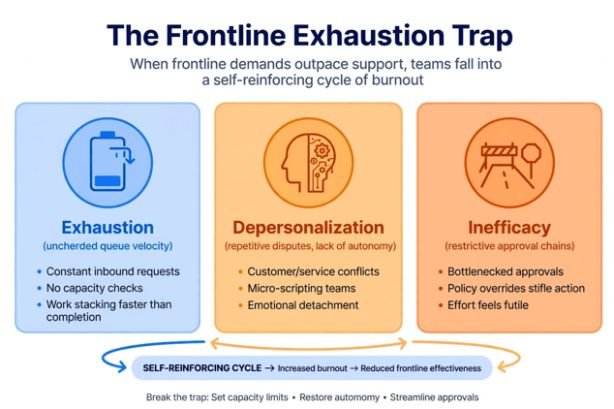
The World Health Organization (WHO) classifies occupational burnout as an unmanaged chronic workplace syndrome characterized by exhaustion, cynicism, and reduced professional efficacy. Frontline service professionals face distinct vulnerabilities due to continuous emotional labor—the effort required to display organizationally desired emotions during high-stress customer disputes.
Research published in Harvard Business Review indicates that systemic burnout stems from operational design rather than personal fragility. When workers face relentless incoming volume without autonomy, physiological stress spikes. Cortisol levels remain elevated, accelerating cognitive fatigue.
| Burnout Dimension | Operational Root Cause | Observable Symptom | Corrective Action |
| Exhaustion | Unchecked queue velocity; zero buffer time | Rising absenteeism; tardiness | Enforced queue pacing; mandatory buffers |
| Depersonalization | Repetitive disputes; lack of autonomy | Curt, mechanical responses | Discretionary compensation budgets |
| Inefficacy | Restrictive approval chains | Escalation bottlenecking | Low-tier resolution sign-off thresholds |
Emotional Labor vs. Cognitive Capacity
Customer service representatives continuously toggle between complex technical problem-solving and emotional regulation. Handling back-to-back contentious calls depletes executive functioning, forcing agents into reactive survival modes. To fix this, teams need an operational efficiency audit to expose friction points in ticketing workflows before reps hit their breaking point.
Redesigning Frontline Operations to Mitigate Chronic Fatigue
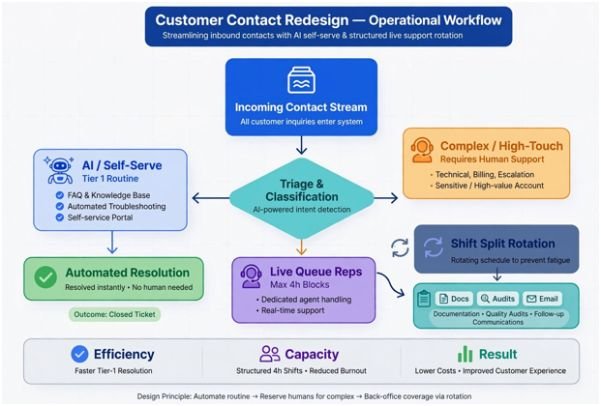
Preventing chronic exhaustion requires re-engineering how agents spend their day. Monotonous, emotionally taxing interactions must be balanced against low-intensity administrative tasks.
Incoming Contact Stream
│
▼
┌──────────────────┐ Tier 1 Routine ┌─────────────────────────┐
│ AI / Self-Serve │ ──────────────────────> │ Automated Resolution │
└──────────────────┘ └─────────────────────────┘
│
│ Complex / High-Touch
▼
┌──────────────────┐ Shift Split ┌─────────────────────────┐
│ Live Queue Reps │ <─────────────────────> │ Back-Office Tasks │
│ (Max 4h Blocks) │ │ (Docs, Audits, Email) │
└──────────────────┘ └─────────────────────────┘
Implementing Asynchronous Task Rotation
Exposing staff to high-friction channels for eight consecutive hours accelerates attrition. High-performing teams divide shifts into split schedules, rotating agents between synchronous phone channels and asynchronous queues like email or documentation review.
Predictable scheduling forms the foundation of stability. Leaders should integrate strict fair workweek compliance standards, giving agents advance notice of their shifts to enable real cognitive rest away from the job.
Automating Transactional Friction
Routine inquiries—order status lookups, password resets, and simple billing questions—drain cognitive reserves. Deploying intelligent virtual agents and self-service portals filters out repetitive operational noise.
Human representatives are then reserved for high-context, high-empathy problem-solving, which according to analytics from Gallup, dramatically boosts an employee’s sense of personal accomplishment.
Decoupling Evaluation from Toxic Speed Metrics

Traditional service operations often evaluate staff on Average Handle Time (AHT). This single metric frequently causes significant stress among frontline employees. When leadership rewards shorter calls, agents face a direct conflict between solving customer issues thoroughly and meeting rigid internal timing thresholds.
To eliminate this operational contradiction, high-retention organizations replace speed quotas with holistic quality metrics.
| Legacy Metric | Operational Flaw | Modern Replacement Metric | Strategic Benefit |
| Average Handle Time (AHT) | Encourages rushed, incomplete interactions | First Contact Resolution (FCR) | Prioritizes complete resolution over speed |
| Total Closed Tickets | Penalizes complex troubleshooting | Customer Satisfaction (CSAT) | Rewards empathy, competence, and care |
| Queue Occupancy Rate (>85%) | Induces chronic adrenaline response | Targeted Occupancy (70–75%) | Provides natural breathing room between calls |
Operationalizing the Post-Incident Decompression Protocol
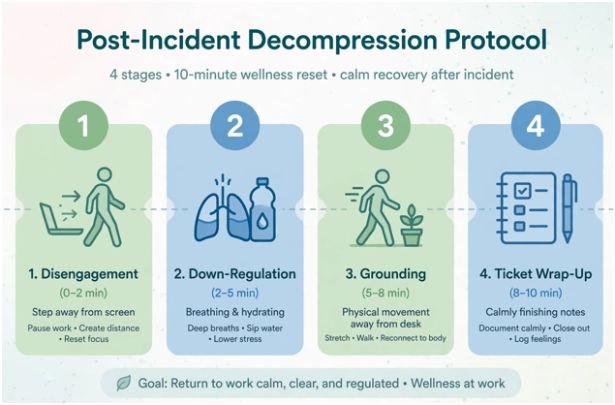
Severe customer escalations trigger acute physical stress responses. Forcing an agent to take another queue interaction immediately following an aggressive interaction damages mental well-being and elevates turnover risk.
Organizations must implement an explicit, non-punitive decompression protocol to normalize recovery.
| Stage | Duration | Core Action Items | Primary Goal |
| 1. Disengagement | Minutes 0–2 | Change queue status to “Post-Incident Reset”; step away from screen. | Halt incoming call routing; break visual engagement. |
| 2. Down-Regulation | Minutes 2–5 | Practice physiological sighing (two inhales, prolonged exhale); hydrate. | Lower heart rate; clear immediate adrenaline spike. |
| 3. Grounding | Minutes 5–8 | Physical movement away from workstation; sensory re-orientation. | Break mental rumination on the conflict. |
| 4. Ticket Wrap-Up | Minutes 8–10 | Record objective facts without emotional commentary; flag for lead review. | Finalize ticket; re-enter queue with clear mind. |
Federal workplace wellness guidance from the U.S. Department of Labor underscores that structured, protected breaks are essential for maintaining safety, cognitive focus, and productivity in high-intensity operational roles.
Frequently Asked Questions
1. What are the earliest warning signs of frontline employee burnout?
Early signs include uncharacteristic cynicism, rising absenteeism, falling first-contact resolution rates, and emotional detachment during standard customer calls.
2. How does workforce scheduling affect agent mental health?
Erratic schedules disrupt circadian rhythms and personal recovery, whereas predictable shifts and protected breaks significantly lower baseline stress.
3. Can AI help reduce turnover among customer support staff?
Yes, conversational AI handles repetitive transactional inquiries, leaving representatives to resolve complex tickets that offer higher personal satisfaction.
4. Why does Average Handle Time drive staff exhaustion?
AHT forces agents to prioritize clock-watching over empathy, causing severe friction between customer needs and management expectations.
Stop Handing Out Pizza: Build Better Infrastructure Instead
Frontline agents do not quit customer service because they dislike helping people; they quit systems that treat their mental stamina as an inexhaustible resource. Banish vanity wellness perks and invest in concrete operational changes.
Audit your metrics, enforce micro-break protocols, and distribute channel demands evenly. Begin by reviewing your handle-time targets this quarter to give your frontline team the breathing room they need to thrive.
Leave a Reply