
Your payroll reports might show steady hourly wages, yet your operating checking account mysteriously runs dry by month’s end. When I audited my first service business, I realized gross wages represent only two-thirds of actual workforce expenses. Mastering how to calculate labor cost percentage for small business operations reveals precisely what share of every revenue dollar keeps your team functioning.
If that number climbs untracked, your business subsidizes inefficiency instead of producing profit.
The Core Labor Cost Percentage Formula

The calculation divides total burdened labor expenses by gross operational revenue across identical accounting windows:
$$\text{Labor Cost Percentage} = \left(\frac{\text{Total Labor Cost}}{\text{Total Revenue}}\right) \times 100$$
Both figures must stem from the identical calendar window. Mismatched accrual dates produce deceptive ratios.
Step 1: Quantify Fully Burdened Labor Costs (Avoid the Phantom Payroll Trap)
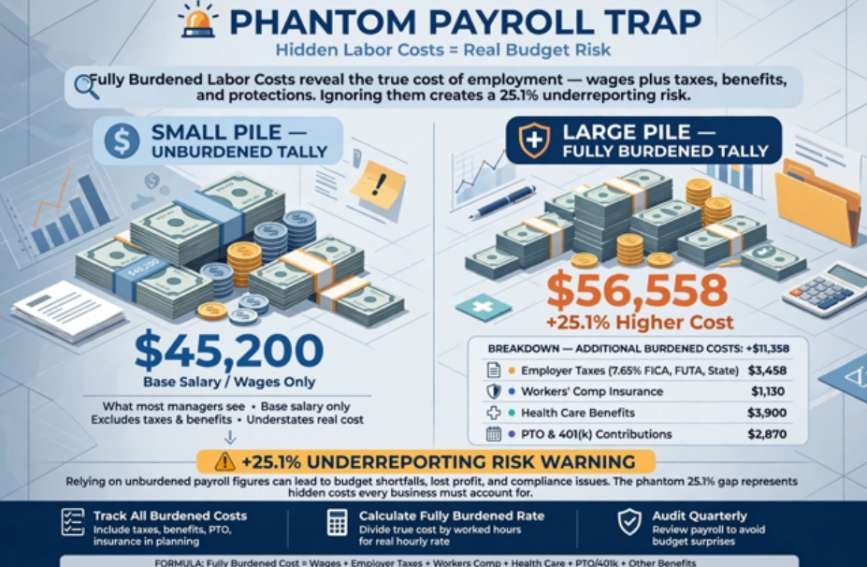
The most damaging mistake I see operators make involves tallying hourly wages alone. Federal and state mandates, benefits, and insurance create an expense layer known as the labor burden.
According to data compiled by the U.S. Bureau of Labor Statistics, non-wage benefits and statutory contributions account for roughly 30% of total employer compensation costs across private industry. Ignoring these items causes the “Phantom Payroll Trap”—an artificial margin that blinds you to operational losses.
Your total labor figure must encompass all compensation commitments defined under IRS Publication 15:
- Direct Compensation: Base wages, salaried payroll, production bonuses, commissions, tips paid by the house, and overtime premiums.
- Statutory Employer Contributions: Employer-paid FICA (6.2% Social Security, 1.45% Medicare), federal unemployment tax (FUTA), and state unemployment insurance (SUTA).
- Mandatory and Discretionary Benefits: Workers’ compensation insurance premiums, employer-paid medical/dental plans, and retirement match contributions.
- Compensated Absence Accruals: Paid time off, holiday pay, and accrued bereavement or sick leave.
- Owner-Operator Market Salary: If you manage daily tasks without a scheduled payroll draw, include your replacement market wage. Free owner labor masks operational insolvency.
Burdened vs. Unburdened Labor Expense Breakdown
The table below illustrates how true payroll burden expands total labor overhead for an eight-person staff:
| Cost Component | Unburdened Tally | True Fully Burdened Tally | Notes on Variance |
| Gross Wages & Salaries | $42,000 | $42,000 | Base hourly and exempt payroll |
| Overtime Premiums | $3,200 | $3,200 | Time-and-a-half allocations |
| Employer Payroll Taxes | $0 (omitted) | $3,458 | FICA, FUTA, and SUTA obligations |
| Workers’ Comp & Health Care | $0 (omitted) | $5,800 | Premiums allocated per period |
| PTO Accruals & 401(k) Match | $0 (omitted) | $2,100 | Earned leave plus company match |
| Total Labor Cost Figure | $45,200 | $56,558 | +25.1% underreporting risk |
Calculating against $45,200 yields false confidence. You must run ratios against $56,558.
Step 2: Establish Matched Gross Revenue
Gross revenue comprises total top-line sales receipts generated during the corresponding calendar cycle. Pull this number straight from your point-of-sale or accounting software before subtracting operating expenses, inventory costs, or debt service.
If calculating for an April 1–April 30 payroll window, match it against April 1–April 30 gross billings. Mixing two-week payroll cadences with monthly sales aggregates distorts your percentage by up to 14%.
The U.S. Small Business Administration highlights that aligning accounting periods ensures accurate operational forecasting.
Businesses operating across multiple locations should also maintain consistent scheduling practices and review a fair workweek compliance checklist for multi-unit businesses to keep labor planning organized.
Step 3: Run the Calculation with a Real-World Scenario
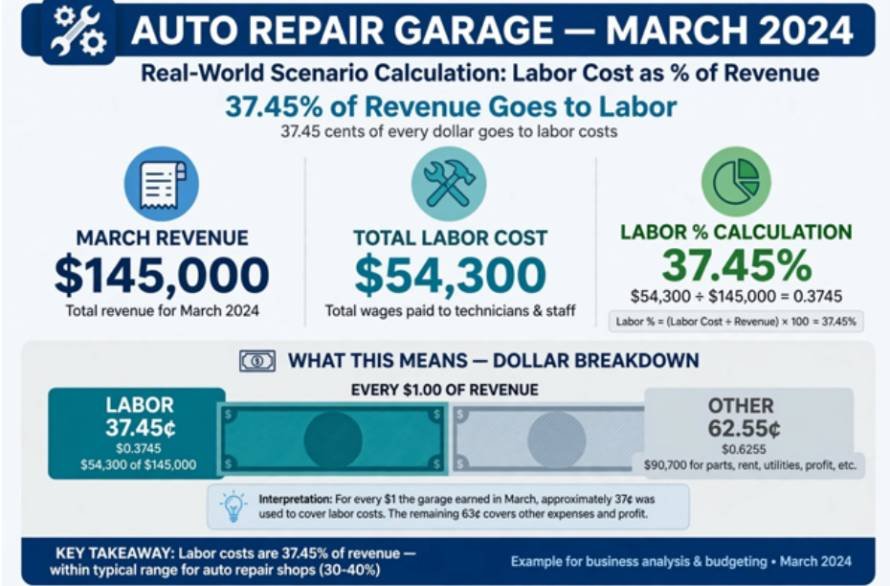
Let us evaluate an independent auto repair garage assessing its financial performance for March:
- Gross Sales (Total Revenue): $145,000
- Hourly Tech & Service Writer Wages: $36,000
- Employer Taxes, Workers’ Comp, & Benefits: $11,800
- Owner-Operator Working Wage: $6,500
- Total Fully Burdened Labor: $54,300
$$\text{Labor Cost Percentage} = \left(\frac{\$54,300}{\$145,000}\right) \times 100 = 37.45\%$$
Labor consumes 37.45 cents of every dollar entering the register.
Industry Benchmarks: What Does a Healthy Percentage Look Like?
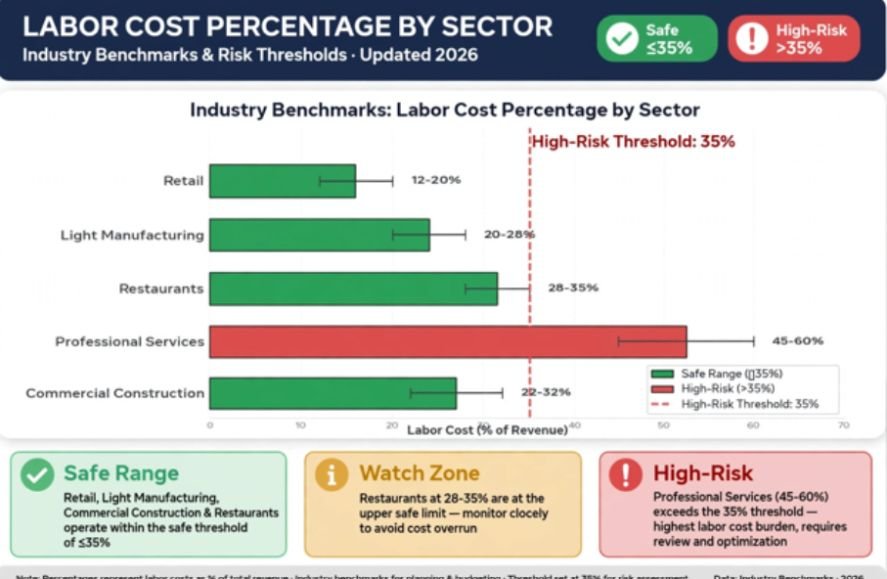
Safe payroll thresholds vary widely by sector. Research from hospitality institutions like the Cornell University School of Hotel Administration demonstrates that customer-facing hospitality models require elevated staffing levels, whereas capital-heavy sectors prioritize asset utilization over headcount.
| Industry Vertical | Typical Safe Range | High-Risk Margin Threshold | Primary Driver |
| Retail & E-commerce | 12% – 20% | > 25% | Automated checkout & self-service merchandising |
| Light Manufacturing | 20% – 28% | > 32% | Capital equipment vs. assembly-line headcount |
| Restaurants & Hospitality | 28% – 35% | > 38% | Shift prep, table service, and kitchen staffing |
| Professional Services | 45% – 60% | > 65% | Billable talent constitutes the inventory sold |
| Commercial Construction | 22% – 32% | > 36% | Project-based craft trades and union rates |
Four Strategic Levers to Optimize Your Labor Ratio
When margins tighten, knee-jerk layoffs harm company morale. Preventing burnout among customer-facing staff is another important part of maintaining productivity without simply increasing headcount. Protect profits with operational adjustments first:
Protect profits with operational adjustments first:
- Schedule to Sales Demand Curves: Map historical revenue velocity by hourly intervals. Stagger shift starts to match real foot traffic rather than staffing arbitrary eight-hour blocks.
- Track Labor Cost Per Unit Produced: In service or manufacturing workflows, calculate labor cost per repair order, meal served, or pallet packed. Monitoring workload and team efficiency can also help identify issues that contribute to peer conflict among frontline workers. Team efficiency becomes visible immediately.
- Automate Administrative Overhead: Eliminate repetitive clerical tasks. Route appointment scheduling, standard billing queries, and timesheet logging through digital software.
- Tie Incentive Pay to Gross Margin: Swap discretionary annual perks for performance-based bonuses funded exclusively when team labor metrics remain below target.
Frequently Asked Questions
1. Should contract 1099 labor be included in the formula?
Yes, add 1099 payments when contractors perform operational production tasks directly tied to core revenue generation.
2. How often should small businesses calculate labor cost percentages?
Calculate your percentage weekly for hourly operations like restaurants, and monthly for salaried professional firms.
3. Does overtime pay inflate this percentage permanently?
Overtime raises the ratio immediately because premium pay increases labor expenses without producing proportional revenue gains.
4. Why do professional service firms sustain higher labor cost percentages?
Consulting, accounting, and legal practices sell intellectual labor rather than raw physical goods, creating minimal material expenses.
Stop Bleeding Cash: Your Weekly Action Blueprint
Operating without tracking your labor cost percentage resembles driving cross-country with a broken fuel gauge. Download your latest monthly payroll summary, pull your gross revenue report, apply the fully burdened formula, and plot your number against your industry’s safe threshold. If your labor sits five points above average, restructure shift scheduling and trim non-productive overtime this week.
Leave a Reply