
Frontline friction is rarely personal; it is operational. When two nurses, retail associates, or line cooks clash during a lunch rush, telling them to “communicate better” solves nothing. Knowing how to handle peer conflict among frontline workers requires recognizing that high-stress shifts trigger physiological threat responses that derail standard reasoning.
Over a decade running operations in fast-paced retail and healthcare settings taught me that workplace hostility stems from friction in the physical workflow. If you want to stop peer flare-ups, you have to fix the environment that creates them.
The Root Drivers of Frontline Team Friction
Frontline employees do not operate behind soundproof office doors. They work shoulder-to-shoulder under bright fluorescent lights, persistent noise, and urgent customer demands. When conflict explodes, managers reflexively blame attitude. That diagnosis is usually wrong.
Environmental Fatigue vs. Intentional Sabotage

Adrenaline spikes during peak service hours. Research documented by the Cornell ILR School confirms that high-strain job structures amplify interpersonal counterproductive work behaviors.
When a colleague seems short-tempered or uncooperative, they are often experiencing autonomic nervous system overload. A worker fighting sensory saturation cannot process nuance. Labeling an employee “toxic” when they are simply cognitively depleted ensures the conflict persists.
Failed Shift Transitions
The most explosive peer disputes happen at shift change. An incoming worker arrives to unstocked shelves, uncleaned stations, or unresolved customer issues left by the outgoing crew.
Resentment accumulates silently until a minor disagreement sparks a shouting match. Deploying an established standard operating procedures template for shift handovers eliminates ambiguous expectations and stops finger-pointing before it starts.
A Step-by-Step De-escalation Framework for Shift Leaders
Managing a peer fight on an active floor requires swift, physical intervention. The following protocol defuses active disputes without disrupting customer operations.
Step 1: Enforce the 10-Minute Off-Floor Cooling Buffer
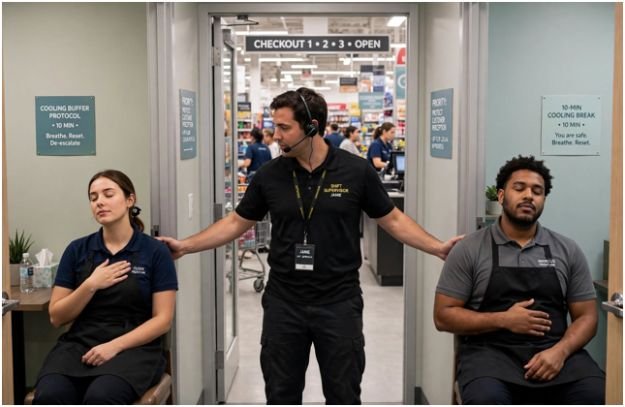
Never force workers to discuss an argument while their heart rates are elevated. Pull both parties off the floor immediately to protect customer perception and employee dignity. According to the Occupational Safety and Health Administration, untreated floor tension increases workplace violence risks and workplace injuries.
Separate the individuals physically into distinct rooms or quiet spaces. Mandate a strict ten-minute silent buffer. Do not demand statements or apologies during this window. Let neurobiology do the work: adrenaline takes several minutes to metabolize back to baseline levels.
Step 2: Separate Workflow Breakdowns from Personality Clashes
Once breathing stabilizes, bring the workers together in a neutral room. Ban character attacks. Focus strictly on operational touchpoints. Shift the dialogue from subjective feelings to objective actions using this conversational script:
| Destructive Accusation | Operational Reframe |
| “You were lazy and dumped all the prep work on me.” | “The station lacked sliced prep items when the 1:00 PM rush began.” |
| “You ignored the registers and left me to drown.” | “Register queues exceeded four customers while primary tasks ran parallel.” |
| “You never communicate during the shift turnover.” | “The handover log was missing notes on broken card terminals.” |
Step 3: Run the Structured SBAR Reset
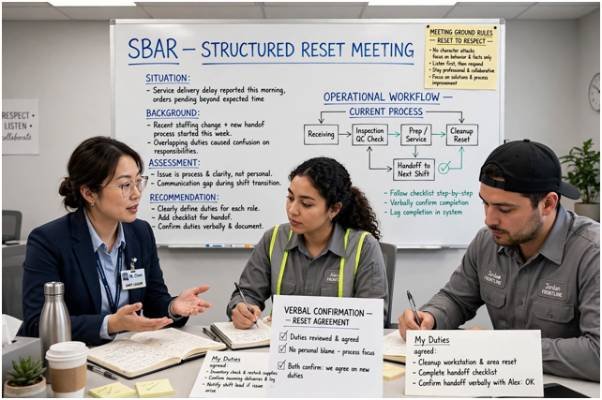
Adapt the healthcare-derived SBAR (Situation, Background, Assessment, Recommendation) model to establish immediate working agreements. This framework strips emotional distortion out of conflict resolution.
Situation: “We have an ongoing backlog at Station 2 during the 4:00 PM transition.”
Background: “The morning crew is handling double the standard intake volume.”
Assessment: “Station 2 needs an extra hand during the 30-minute changeover window.”
Recommendation: “Worker A covers intake; Worker B clears the backlog until 4:30 PM.”
Facilitate the agreement, write down the designated duties, and require both team members to verbally confirm their commitments.
Peer Conflict Resolution Strategies Compared
Intervention methods must match the severity and frequency of the dispute. The matrix below outlines how to evaluate and select the right response:
| Resolution Method | Best Operational Fit | Primary Limitation | Escalation Trigger |
| Peer-to-Peer Alignment | Minor misunderstandings over task distribution. | Requires both peers to possess baseline emotional regulation. | Any personal insults or verbal attacks. |
| Supervisor Mediation | Chronic friction that degrades shift throughput. | Consumes supervisor floor time during active shifts. | Failure to meet written agreements. |
| Formal HR Investigation | Contractual breaches, wage disputes, harassment claims. | Slow turnaround; does not resolve real-time floor friction. | Violations cited by SHRM compliance standards. |
Institutionalizing Conflict Prevention on the Shift

Reactive mediation wears leaders down. Preventing conflict requires building systems that make fair workloads transparent. Transparent scheduling tools, cross-training programs, and clear station rotations remove the perception of favoritism.
When employees trust the schedule, peer friction drops drastically. Stable, predictable workflows also help organizations reduce absenteeism in shift work operations, as highlighted in operational studies published by the Harvard Business Review. When peer friction ceases to be a daily hazard, staff retention stabilizes.
Frequently Asked Questions
1. What causes most peer conflicts among frontline workers?
Unclear task handovers, perceived workload imbalances, and cognitive exhaustion during peak operational hours cause most frontline disputes.
2. How quickly should a supervisor intervene in floor conflict?
Intervene immediately to pull workers off the floor, but enforce a 10-minute quiet buffer before mediating.
3. Can peer conflict lead to frontline turnover?
Yes; chronic peer friction creates an emotionally draining environment that drives voluntary turnover and unexcused shift absences.
4. When must frontline conflict go straight to HR?
Escalate immediately when disputes involve threats of violence, discrimination, sexual harassment, or legal safety violations.
Stop Managing Drama, Start Engineering Workflows
Interpersonal friction is rarely a character defect; it is an alarm showing where your operating system is leaking. Do not treat frontline teams like unruly children who need a lecture on politeness. Treat them like skilled operators caught in an engineered bottleneck. Remove the friction points in their daily environment, establish unambiguous handovers, and watch the workplace drama solve itself.
Leave a Reply