Frontline service workers do not quit jobs on day ninety; they quit emotionally during their first four hours. When I ran high-volume store operations, I watched capable recruits walk out mid-shift simply because they were handed a thirty-page manual, an apron, and zero direction. To fix this, you need a battle-tested onboarding checklist for high turnover service industries that prioritizes immediate competence over administrative exhaustion.
According to the Bureau of Labor Statistics, hospitality and retail sectors routinely face annual turnover rates exceeding 70%. Retaining these workers demands a structured workflow that turns chaos into steady competence.
PRE-BOARDING DAY 1: FIRST WIN WEEK 1: SHADOWING DAYS 30-90: RUNWAY
[Mobile Portal: Gusto/ADP] ➔ [Door Greeting + Buddy] ➔ [Reverse-Shadow Tasks] ➔ [Stay Check & Tier Bumps]
The Root Cause: Why Frontline Onboarding Fails by Day Three
Most service operations confuse compliance with training. New hires spend four hours signing tax forms in a noisy back office, get thrown onto a register during a rush, and leave overwhelmed. Research published by the Cornell Center for Hospitality Research confirms that early role clarity correlates directly with employee longevity.
Frontline turnover happens because of three friction points:
- Administrative fatigue: Trainees waste their first day on paperwork instead of connecting with their team.
- Social isolation: Nobody greets the new recruit, leaving them stranded at the counter.
- Execution anxiety: Workers are expected to run complex stations before mastering basic steps.
Improving frontline retention requires building long-term operational efficiency into the training lifecycle rather than treating orientation as an afterthought.
The 4-Phase Frontline Onboarding Checklist
This system breaks onboarding into distinct, low-stress intervals to protect team bandwidth and employee confidence.
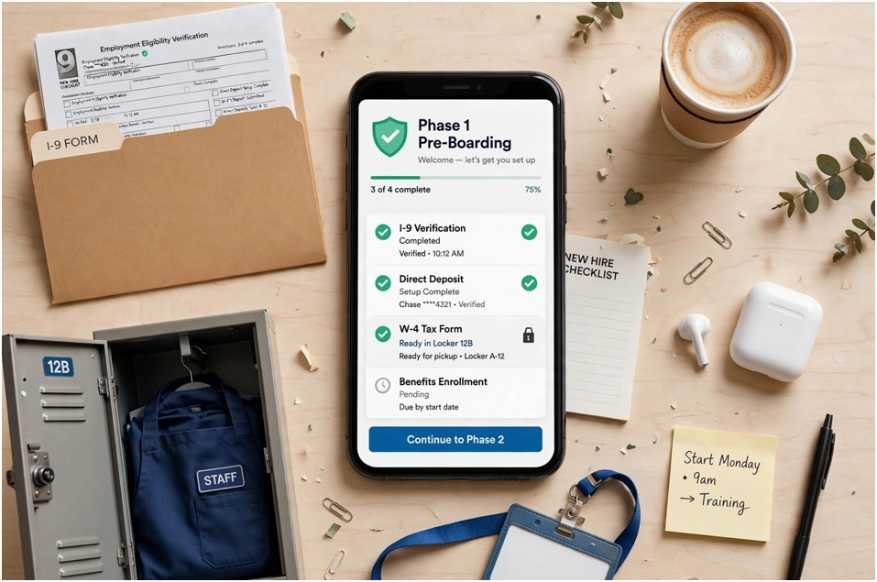
Phase 1: Pre-Boarding & Digital Compliance

Clear every bureaucratic hurdle before the employee steps through your doors.
- Send contracts, I-9 verification, and direct-deposit setup through a mobile-friendly onboarding app.
- Provision point-of-sale accounts and scheduling logins 48 hours in advance.
- Send an automated SMS confirming parking spots, the dress code, and the name of the shift supervisor.
- Stage clean uniforms, nametags, and safety gear in their assigned locker.
Phase 2: The “First Shift Win” Protocol
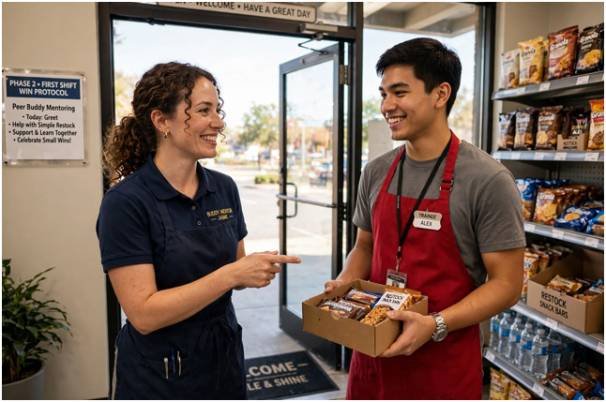
Day one must focus exclusively on comfort, safety, and an easy psychological victory.
- Meet the recruit at the entrance immediately so they never wait awkwardly in customer areas.
- Conduct a ten-minute essentials tour covering break rooms, restrooms, and emergency exits.
- Pair the worker with a designated peer buddy who receives a shift stipend for their mentorship.
- Assign one low-stakes task within hour two, such as restocking dry goods or cleaning a prep station, so they complete their shift feeling capable.
- Run a fifteen-minute exit debrief to answer questions and confirm their next scheduled shift.
Phase 3: The 7-Day Reverse-Shadowing Model

Week one establishes technical muscle memory through observation and supervised execution.
- Walk through your documented standard operating procedures using laminated station cheat sheets.
- Execute active shadowing: the trainee watches the buddy for one shift, then reverses roles on shift two.
- Practice high-stress scenarios through brief mock interactions before peak customer rushes hit.
- Deliver real-time micro-corrections on the floor to eliminate errors before bad habits form.
- Complete a ten-minute performance alignment at the end of the week to review baseline milestones.
Phase 4: The 30-60-90 Retention Runway

The Society for Human Resource Management (SHRM) highlights that structured check-ins during the first quarter dramatically suppress early resignation spikes.
- Day 30: Review core performance metrics, address signs of early burnout, and celebrate initial wins.
- Day 60: Cross-train the employee on a complementary station to keep daily tasks engaging.
- Day 90: Conduct an informal stay interview to gather honest feedback on operational bottlenecks and discuss pay tier increases.
Frontline Onboarding Matrix: Reference & Action Table
Use this operational matrix to assign accountability across your shift leads.
| Phase | Timeline | Core Objective | Primary Deliverable | Responsible Party |
| Pre-Boarding | 3–5 days prior | Complete 100% of compliance digitally | Portal paperwork & system credentials | GM / HR Lead |
| Shift One | Hours 1–6 | Reduce anxiety; secure a quick win | Locker assignment & single task sign-off | Peer Buddy |
| Foundation | Days 2–7 | Build station execution consistency | Reverse-shadowing verification sheet | Shift Supervisor |
| Runway | Days 30–90 | Secure retention; expand station skills | Cross-training check & stay interview | General Manager |
Stop the Bleed: Turn Onboarding Into Your Retention Engine
High turnover is rarely an inevitable byproduct of the service sector; it is the natural outcome of neglectful first impressions. As noted in insights from the Harvard Business Review, structured socialization early on solidifies employee attachment.
When you automate paperwork, assign dedicated peer support, and celebrate micro-wins, new hires stay. Implement this checklist on your next hiring batch to protect your labor margins and stabilize your shifts.
Frequently Asked Questions
1. What is the most important step in service industry onboarding?
Pairing a new recruit with an incentivized peer buddy on day one delivers immediate clarity and halts first-week resignations.
2. How do you onboard frontline staff when short-staffed?
Complete all compliance paperwork through mobile pre-boarding portals so shift leads spend zero floor time on administrative filings.
3. What should be included in a Day 1 service cheat sheet?
Provide concise details on parking, uniform requirements, locker locations, manager contact numbers, and basic time-clock instructions.
4. Why do service workers quit during the first week?
They quit due to execution anxiety, nonexistent training, and feeling abandoned by management during peak customer service rushes.
Leave a Reply