
Running an independent boutique taught me that shrinkage does not announce itself with shattered glass. It quietly erodes operating margin through uncounted boxes, sloppy refunds, and blind inventory drifts. Mastering these inventory shrinkage prevention tips for small retail transformed my ledger, cutting unallocated losses from 2.4% of total sales down to a lean 0.35%.
According to annual data compiled by the National Retail Federation, inventory shrinkage costs retailers upwards of $100 billion annually. For an enterprise brand, an unrecorded case of goods is a write-off. For an independent merchant, it is next month’s payroll. Controlling it requires disciplined shop-floor habits rather than expensive enterprise surveillance.
The Core Sources of Retail Loss (And How They Compound)
Shrink stems from four distinct vectors: shoplifting, internal theft, administrative blunders, and vendor fraud. While shoplifting commands headlines, my own balance sheets proved that bad data and unmonitored backroom doors drain equal amounts of cash.
| Shrink Vector | Industry Average Share | Primary Operational Root Cause | Primary Intervention Point |
| External Theft | ~36% | Poor sightlines and unmonitored exits | Architectural layout & deliberate customer greetings |
| Internal Theft | ~29% | Unrestricted POS permissions and lax till audits | Role-based POS permissions & daily blind till counts |
| Process / Admin Errors | ~27% | Untracked inventory adjustments & damaged write-offs | Real-time POS syncing & weekly cycle counts |
| Vendor Fraud | ~8% | Blind signing of delivery manifests | Mandatory piece-by-piece bill-of-lading matching |
Conducting an operational efficiency audit reveals where paperwork fails physical inventory. When cashiers issue loose discounts or forget to log damaged floor models, your balance sheet reflects ghost stock. Research featured in the Harvard Business Review shows that inventory distortion cripples operating cash reserves faster than standard demand downturns.
Differentiating Administrative Drift from Active Theft
Administrative shrinkage occurs quietly in spreadsheets. When an employee marks an unreturned item as active inventory, your system reorders inventory prematurely. Conversely, employee theft manifests through sweethearting: friends receiving unauthorized markdowns or cashiers pocketing cash from processed voids. Addressing both requires separating routine recordkeeping from physical stock handling.
Re-Architecting Floor Layout for Active Deterrence
Floor layout represents your first line of defense. Shoplifters rely on dead zones, tall fixtures, and distracted cashiers. During my second year managing floor operations, I lowered central retail fixtures to 48 inches. This simple shift created unbroken sightlines from the cash wrap to the main entrance.
Data from the Loss Prevention Research Council demonstrates that visible employee engagement deters shoplifting more effectively than hidden security hardware. Position cash wraps directly adjacent to store entrances. Customers must acknowledge an employee upon crossing the threshold, stripping away anonymity.
Store owners should place high-theft merchandise—defined by compact size and high secondary-market resale value—within direct peripheral vision of staffed stations. When dealing with premium designer accessories, locked tethering cables or enclosed acrylic display cases safeguard high-ticket stock while maintaining visual merchandising standards.
POS Controls and Internal Oversight

Trusting your team does not negate the necessity of strict system guardrails. A point-of-sale system without role-based access invites balance sheet drift. Restrict manual price adjustments, invoice voids, and no-sale drawer operations strictly to store managers.
| Cash Wrap Risk Vector | Vulnerability Detail | Enforced SOP |
| Post-Tender Voids | Cashier keeps cash, cancels transaction | Require manager biometric or keycode approval |
| Manual Price Overrides | Cashier applies unauthorized promotional pricing | Lock override features behind supervisor credentials |
| Unrecorded Returns | Fraudulent merchandise refund credited to personal card | Require original receipt and matching customer ID |
| Blind Drawer Drops | Till variance disguised during shift transitions | Enforce blind balancing without drawer target readouts |
Managing Manager Overrides and Voids
Institute a zero-tolerance policy for shared administrative credentials. When every staff member uses the head-cashier pin to void mistakes, audits become impossible. Implement blind drawer counts at shift changes; cashiers count cash drawers without viewing expected totals beforehand. Pairing these measures with broader strategies to lower operating costs prevents avoidable margin loss at the register.
Eliminating Back-Door Receiving Leaks

Merchandise loss often begins before products reach display shelves. The receiving dock remains vulnerable because shipments arrive during high-traffic sales hours. Delivery drivers are often rushed, tempting employees to sign bills of lading blindly.
The U.S. Small Business Administration highlights internal oversight as a core defense against cash bleed. Enforce a rule that no receiving door stays unlocked without an active staff member present. Delivery drivers must remain in the loading bay and should not enter backrooms or inventory staging areas.
Implementing Blind Delivery Verifications
Do not hand incoming delivery manifests directly to stocking teams. Provide a blank receiving log instead. The employee records carton quantities, inspects outer seal integrity, and logs item codes manually. Only after completing this physical count does management compare records against the vendor packing slip. Any discrepancy triggers a vendor notification within 24 hours.
The 48-Hour Velocity Discrepancy Framework
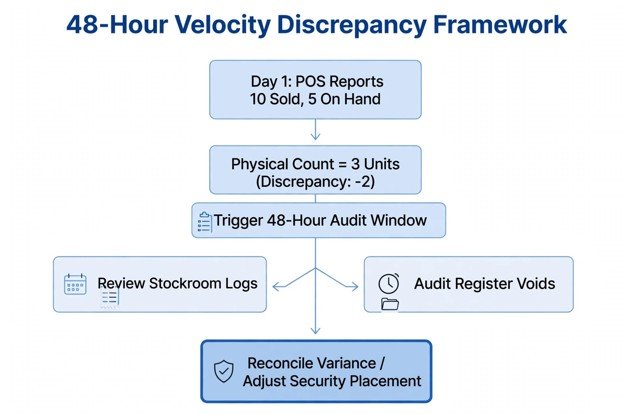
Annual inventory audits yield outdated findings too late to recover capital. I apply a rolling cycle audit based on sales velocity and item cost:
$$\text{Shrink Risk Score} = \text{Unit Cost} \times \text{Weekly Sales Velocity}$$
Any item ranking in the top 10% of this risk metric requires an inventory count every Tuesday and Thursday morning.
[Day 1: POS Reports 10 Units Sold, 5 On Hand]
│
▼
[Physical Count = 3 Units] ──► (Discrepancy: -2 Units)
│
▼
[Trigger 48-Hour Audit Window]
┌───────────────┴───────────────┐
▼ ▼
[Review Stockroom Logs] [Audit Register Voids]
│ │
└───────────────┬───────────────┘
▼
[Reconcile Variance / Adjust Security Placement]
When physical counts fall short of registered inventory, investigate within 48 hours. Review security footage, inspect stockroom waste bins, and audit register transaction logs for that specific SKU. Catching patterns early prevents isolated errors from ballooning into persistent inventory losses.
Stop Bleeding Cash: Your Immediate Next Step
Shrinkage prevention succeeds through disciplined operational rhythm rather than aggressive policing. Lock down administrative POS permissions today, turn your store fixtures outward, and count high-velocity inventory weekly. When staff observe systematic oversight, administrative errors drop and opportunistic theft stops.
Frequently Asked Questions About Retail Shrinkage
1. What is the most common cause of retail shrinkage?
External shoplifting and employee theft account for the majority of retail shrinkage, followed closely by administrative and bookkeeping errors.
2. How do small retailers calculate shrinkage rate?
Divide your total lost inventory value by your total expected retail sales value over the same accounting period, then multiply by 100.
3. How often should small retailers run inventory counts?
High-velocity and high-value merchandise should be cycle-counted weekly, while whole-store physical audits should occur at least biannually.
4. What is sweethearting in retail theft?
Sweethearting occurs when an employee provides unapproved discounts, skips scanning items, or fraudulently voids transactions for friends or family.
Leave a Reply