
I spent a decade running round-the-clock shift crews across heavy manufacturing lines. Early in my career, our plant lost an entire production run because an outgoing operator forgot to mention a recalibrated sensor. The incoming technician assumed standard baseline parameters. By 4:00 AM, thousands of gallons of product spoiled.
That incident proved that verbal promises fail under fatigue. Every operational facility needs a battle-tested standard operating procedures template for shift handovers to eliminate communication gaps, preserve asset uptime, and protect employee safety.
The Handover Cycle
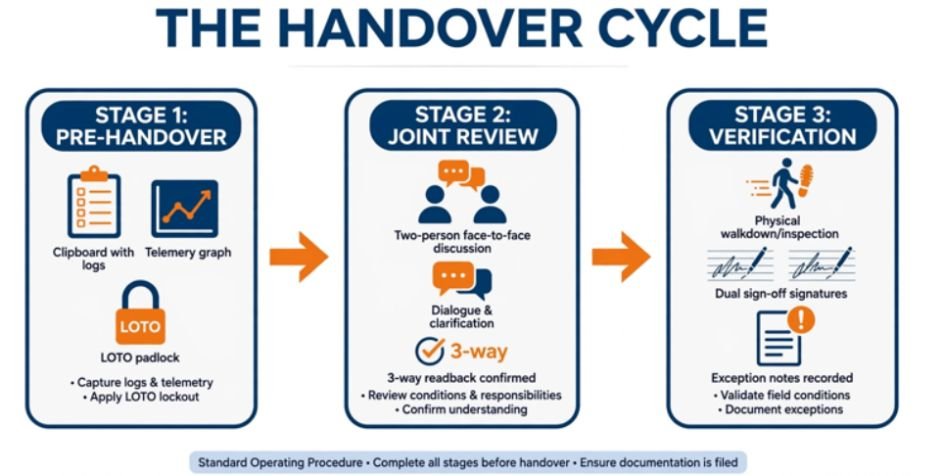
THE HANDOVER CYCLE
┌───────────────────┐ ┌───────────────────┐ ┌───────────────────┐
│ PRE-HANDOVER │ │ JOINT REVIEW │ │ VERIFICATION │
│ Outgoing logs │ ───> │ Face-to-face │ ───> │ Physical walk, │
│ telemetry, LOTO, │ │ 3-way readback │ │ dual sign-off, │
│ and open permits │ │ of active alerts │ │ exception notes │
└───────────────────┘ └───────────────────┘ └───────────────────┘
The Shift Handoff Trap: Why Most SOPs Fail on the Floor
Most facilities treat handovers like casual water-cooler conversations. Team members exchange a two-minute verbal recap, punch their cards, and leave.
According to regulatory analyses from the HSE UK Guidance on Shift Handover Communication, communication breakdown during shift handovers remains one of the primary root causes of major industrial accidents. When fatigue sets in at the end of a twelve-hour shift, working memory drops sharply. People forget crucial operational details.
If your team struggles with unscheduled departures, learning how to reduce absenteeism in shift work operations helps stabilize crew rotations so staff have predictable turnover schedules.
The 3-Way Communication Rule
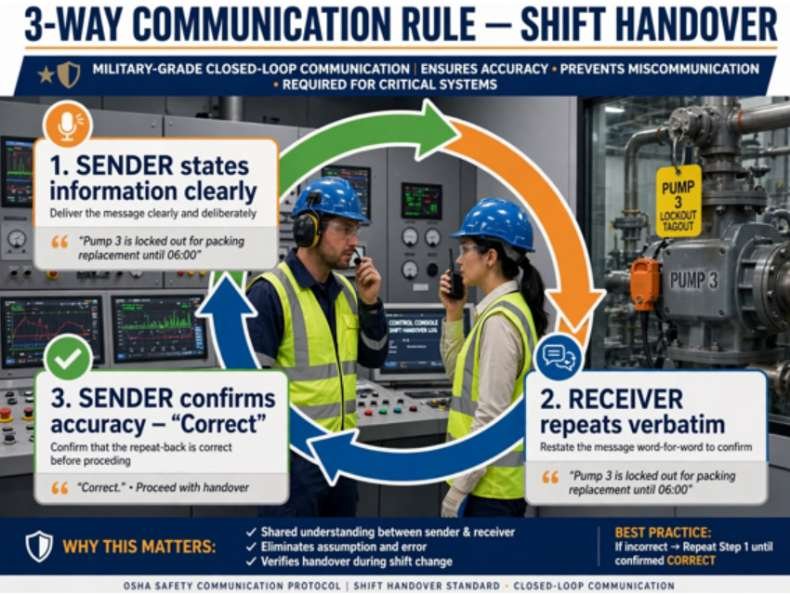
To combat cognitive fatigue, adopt military-grade closed-loop communication:
- Sender states the information clearly (e.g., “Pump 3 is locked out for packing replacement until 06:00”).
- Receiver repeats the message verbatim (e.g., “Understood, Pump 3 is locked out for packing replacement until 06:00”).
- Sender confirms accuracy (“Correct”).
NASA documents this exact protocol inside their NASA Human Systems Integration Guidelines to eliminate interpretation errors during critical system turnovers.
The Master Standard Operating Procedures Template for Shift Handovers
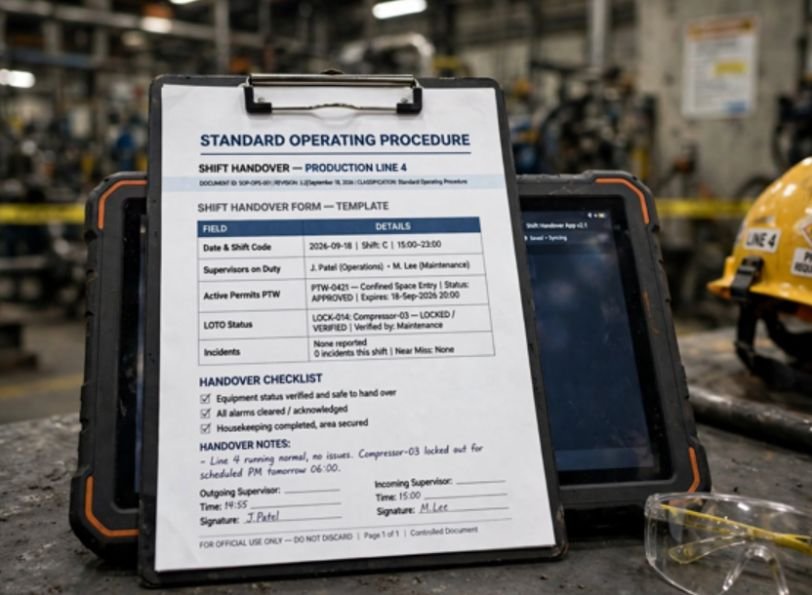
Below is the exact production-ready standard operating procedures template for shift handovers that you can adapt directly for your management system.
DOCUMENT ID: SOP-OPS-001
REVISION: 3.2
EFFECTIVE DATE: September 18, 2026
CLASSIFICATION: Standard Operating Procedure (Shift Transitions)
Section 1: Administrative Scope & Responsibility
- Purpose: Establish a standardized, zero-defect process for transferring operational control between crews.
- Scope: Applies to all rotational operators, technicians, control-room engineers, and supervisors across all operating assets.
- Compliance Baseline: Aligns with OSHA Process Safety Management Guidelines for mechanical integrity and operating procedures.
| Role | Core Handover Duty | Primary Deliverable |
| Outgoing Crew | Pre-compile operational logs, clean workstations, document alarms. | Completed Digital/Physical Handover Log |
| Incoming Crew | Arrive 15 minutes early, review logbook, conduct physical inspection. | Formal Acceptance Sign-Off |
| Shift Supervisor | Audit log completeness, arbitrate contested equipment statuses. | Shift Transfer Endorsement |
Section 2: Step-by-Step Transition Workflow
- Pre-Handover Logging (T-Minus 15 Minutes): The outgoing lead enters all throughput numbers, downtime logs, and pending maintenance orders. Operators ensure station cleanliness and restock consumables.
- Face-to-Face Joint Review (T-Minus 5 Minutes): Outgoing and incoming leads meet at the primary control desk. Both teams execute closed-loop reviews on running jobs and active permits.
- Physical Asset Walk (Transition T-Zero): Both leads walk active operating lines together to visually confirm lockouts, pressure gauges, and physical equipment stops.
- Conditional Sign-Off: Both leads sign the log. If the incoming lead spots an unrecorded problem, they check “Accepted with Exceptions” and call the supervisor.
If your facility operates cross-departmental lines, evaluate our cross training employees benefit matrix to verify whether incoming operators hold active certifications on complex equipment before accepting transfers.
Shift Handover Logbook Reference Tables
Print or configure these reference tables directly into your computerized maintenance management system (CMMS) or station clipboards.
When handover information needs to be accessed away from a central desk, teams can also use how mobile productivity apps increase efficiency for field staff to keep critical updates, task details, and operational notes accessible during transitions.
Part A & B: Identity, Safety, and Compliance Log
| Field | Outgoing Record | Incoming Verification |
| Date & Shift Code | 2026-09-18 | Shift A (Day) | 2026-09-18 | Shift B (Night) |
| Supervisors on Duty | Marcus Vance (Lead) | Sarah Lin (Lead) |
| Active Permits (PTW) | #PTW-8821 (Hot Work Line 2) | Inspected & Confirmed Open |
| LOTO Status | Breaker 4B Padlocked (Tag #104) | Physical Padlock Verified |
| Incidents / Near Misses | 1 Near Miss (Conveyor Jam, 14:20) | Log Reviewed & Countersigned |
Part C & D: Live System Metrics and Action Item Tracker
| Asset / Line ID | Operating State | Current Output / Variance | Immediate Action for Incoming Crew |
| Line 1 – Extruder | Running | 1,420 units/hr (-3% target) | Monitor bearing temperature on roller 4. |
| Line 2 – Packaging | Down (Scheduled) | 0 units/hr (LOTO Active) | Vendor tech arrives at 19:30 for belt splice. |
| Line 3 – Assembly | Running | 980 units/hr (+2% target) | Clean output bin before midnight run. |
Hard Truths from 15 Years of Rotational Shifts
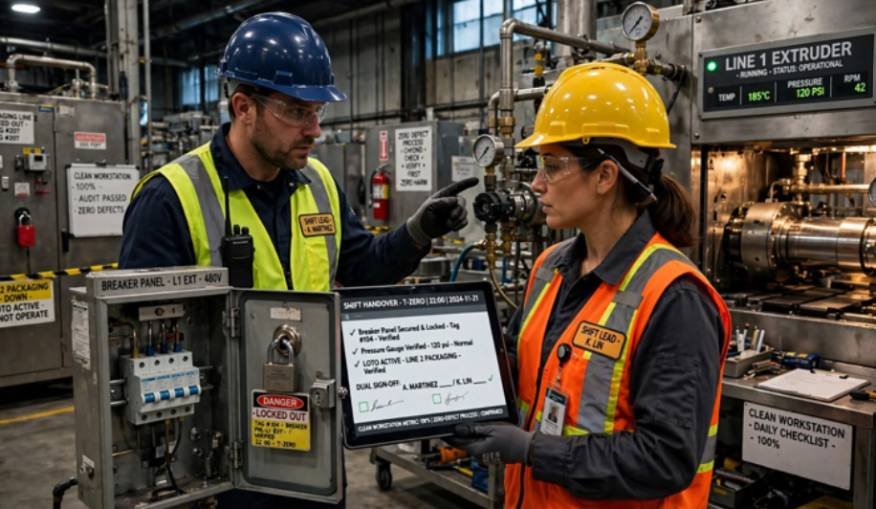
Most handovers fail for psychological reasons rather than technical ones. Outgoing operators want to pack up and get home. Incoming operators need their first cup of coffee and dislike hearing bad news before starting their shift.
Here are three rules I enforce on every floor:
- Never allow solo handovers: Both the outgoing and incoming operators must be standing at the console simultaneously. No passing notes left on clipboards.
- The “Clean Station” metric is not aesthetic: A messy workstation hides leaking seals, worn parts, and missing tools. Messy stations indicate chaotic handoffs.
- Empower incoming teams to reject handovers: If an incoming operator discovers an unlogged mechanical fault or an undocumented Lockout/Tagout, they refuse the handoff until the shift supervisor signs off.
Frequently Asked Questions
1. What should be included in a shift handover template?
A complete template requires administrative shift details, open safety permits (LOTO), system performance metrics, pending maintenance actions, and dual sign-off signatures.
2. How long should an effective shift handover take?
A proper handover takes 10 to 15 minutes, divided into solo preparation, joint face-to-face review, and a physical station walkthrough.
3. Can shift handovers be conducted completely digitally?
Yes, provided the digital platform requires manual field acknowledgments, captures time-stamped signatures, and occurs alongside a verbal conversation.
4. What is the biggest risk of a poor shift handover?
Undetected safety hazards like active energy sources or improperly isolated valves represent the most dangerous risk of an incomplete shift transition.
Stop Running Blind: Your Next Shift Starts Now
Shift turnovers mark the single most vulnerable moment in 24-hour operations. When you rely on informal handoffs, you gamble with production quotas and employee safety.
Take this standard operating procedures template for shift handovers, paste it into your plant documentation, and run an unannounced audit on your next midnight transition. You might be surprised by what your teams leave unsaid.
Leave a Reply