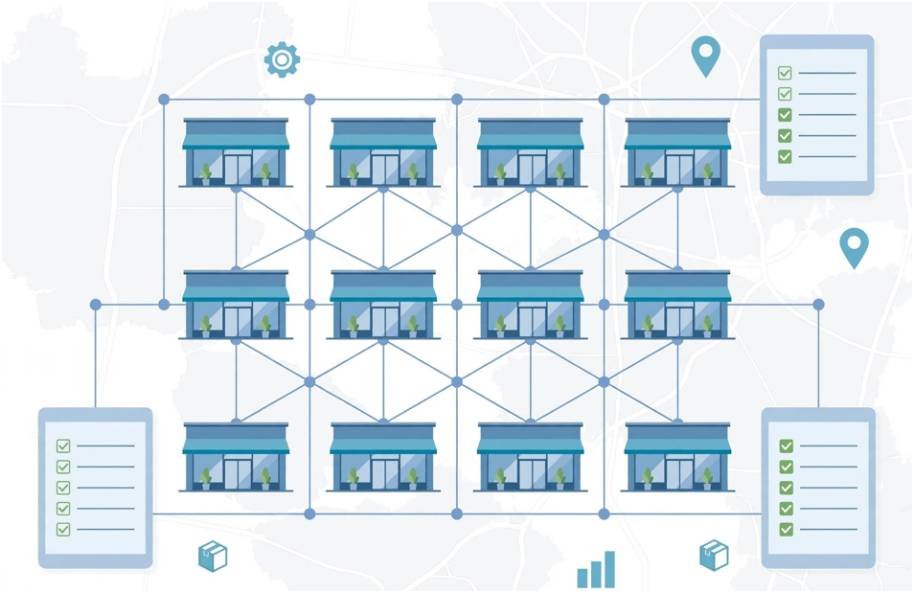
When I expanded my retail footprint from two local storefronts to twelve regional doors, my brand cracked. Opening cash counts drifted, customer onboarding varied across state lines, and inventory shrink climbed 14% in six months.
I quickly learned that tribal knowledge does not scale. If you want consistent customer experiences, you must learn how to build standard operating procedures for multi location stores that your frontline staff will actually use.
Standard operating procedures (SOPs) are not dusty corporate binders. They are the living operational engine that guarantees store twelve runs as reliably as store one.
Categorizing Core Multi-Unit Workflows
Scaling begins by grouping fragmented daily tasks into logical buckets. Fragmented checklists confuse hourly employees and hide systemic operational drift. According to research from the Harvard Business Review, operational ambiguity is the leading driver of multi-unit execution failure.
The 5 Non-Negotiable Operational Pillars
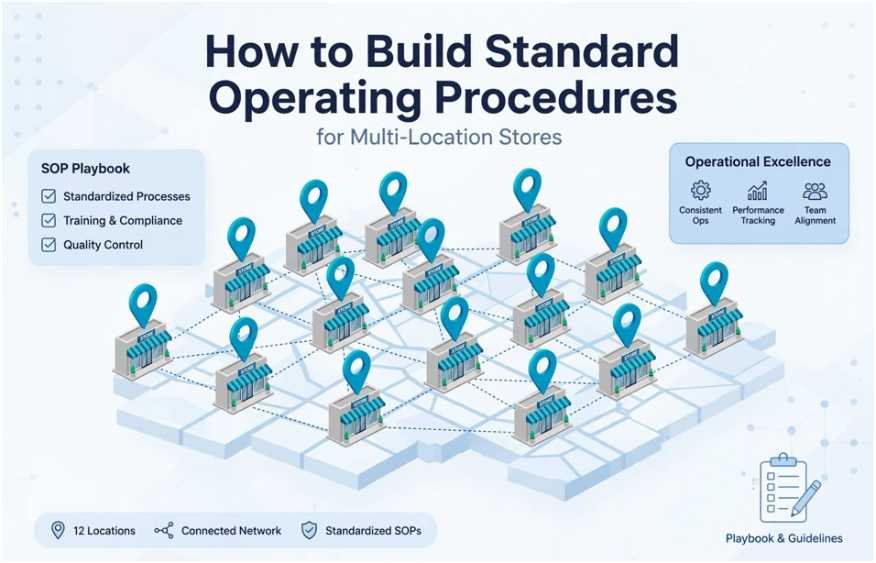
Every multi-unit retail enterprise hinges on five functional areas.
| Operational Pillar | Focus Area | Multi-Store Risk Without SOPs |
| Opening & Closing | Alarm codes, perimeter inspections, safe counts | Cash discrepancies and false alarm penalties |
| Customer Experience | Service recovery, returns, checkout tempo | Fractured brand reputation across regional markets |
| Inventory & Receiving | Manifest verification, cycle counts, RTVs | Unreconciled phantom stock and localized stockouts |
| Workforce Onboarding | Shift handoffs, attendance, safety check-ins | Ramp-up delays and high 90-day frontline turnover |
| Loss Prevention | Shoplifting response, till sweeps, emergency rules | Margin erosion and compromised physical safety |
The 80/20 Rule: Corporate Mandate vs. Store Manager Discretion
A common mistake I made early on was trying to micromanage everything from corporate headquarters. Multi-unit operations require a strict distinction between absolute corporate guardrails and regional flexibility.
I enforce an 80/20 governance protocol: 80% of your SOP library consists of immutable corporate rules, while 20% accommodates local market reality.
┌────────────────────────────────────────────────────────┐
│ 80% NON-NEGOTIABLE CORPORATE MANDATE │
│ • Dual-custody cash drawer drops │
│ • Daily inventory cycle-count triggers │
│ • OSHA and statutory safety reporting │
└────────────────────────────────────────────────────────┘
│
▼
┌────────────────────────────────────────────────────────┐
│ 20% LOCAL STORE DISCRETION │
│ • Visual merchandising for local inventory assortments│
│ • Community event shift allocations │
│ • Local supply sourcing for floor maintenance │
└────────────────────────────────────────────────────────┘
When managing shift handovers, for instance, staff must follow our uniform standard operating procedures template for shift handovers to log till variances, but store managers may adjust the exact handoff time window around local foot-traffic peaks.
A Field-Tested 5-Step SOP Creation Framework
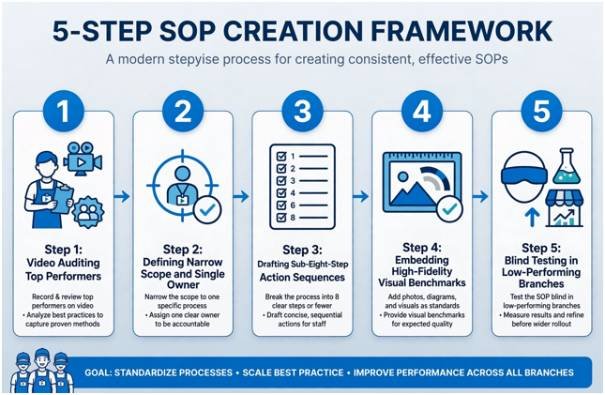
Writing SOPs in an isolated corporate office guarantees non-compliance. I rely on a structured, five-stage rollout system built from the sales floor up.
Step 1: Video Auditing Frontline Top Performers
Never start by writing text. Walk into your highest-performing store, pull out a smartphone, and film your top store manager executing the task. Capture how they scan incoming manifests or balance the evening register float. Capturing frontline technique provides a practical baseline rooted in reality, avoiding ivory-tower workflows that floor teams ignore.
Step 2: Defining Narrow Scope and Single Corporate Owners
Ambiguous ownership causes process decay. Every SOP must address one micro-task and name a single corporate owner responsible for quarterly updates.
| SOP Metadata Element | Operational Standard | Example Baseline |
| Process ID & Title | Direct, action-first phrasing | SOP-OPS-04: Daily Register Float Count |
| Corporate Owner | Single point of operational contact | Director of Retail Operations |
| Trigger Event | Clear temporal or operational condition | 30 minutes prior to unlocking sales floor doors |
| Completion Target | Measurable ceiling for execution time | 12 minutes |
Step 3: Drafting Sub-Eight-Step Action Sequences
Dense walls of text are useless on a busy sales floor. Limit every procedural document to eight or fewer sequential, imperative steps. Start each instruction with a strong verb: Power on, Verify, Scan, Reconcile. If an SOP requires fourteen steps, you do not have one procedure; you have two separate workflows that need dividing.
Step 4: Embedding High-Fidelity Visual Benchmarks
Text creates regional misinterpretation. Visual benchmarks eliminate it. A floor team member should instantly discern acceptable versus unacceptable execution without asking a supervisor.
| Procedural Checkpoint | High-Fidelity Visual Reference | Compliance Distinction |
| POS Till Organization | Overhead photo of slotted bills and rolled coin tray | Pass: Facing bills, no mixed slots.
Fail: Scattered checks, untracked loose change. |
| Backroom Stock Staging | Photo of clear aisle clearance markers | Pass: 36-inch clearance maintained.
Fail: Stock carts obstructing emergency egress. |
| Intake Manifest Tagging | Screenshot of verified inventory receipt in POS | Pass: System-generated green acceptance check.
Fail: Unreconciled line items saved as draft. |
Step 5: Blind Testing in Low-Performing Branches
Before deploying a new procedure chain-wide, test it in your lowest-performing branch. Hand the draft SOP to an assistant manager or new hire without offering verbal guidance. If they make an error, pause and adjust the SOP, not the worker. Field testing exposes unwritten corporate assumptions before they cause regional disruption.
Scaling Digital SOP Systems Across Geographies
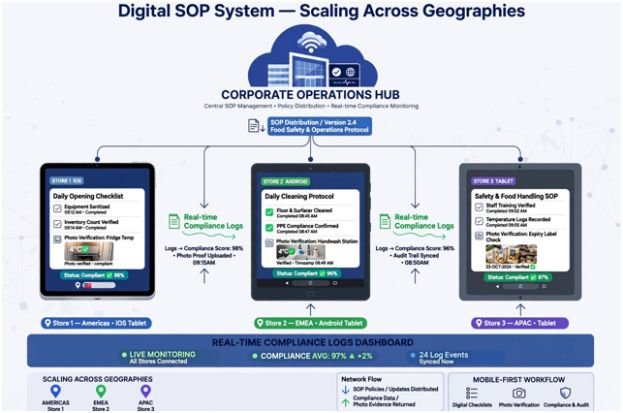
Paper binders on backroom shelves are operational graveyards. Multi-unit operations demand real-time verification through mobile-first workflow software like MaintainX or Trainual. These platforms transform passive documentation into active, verifiable field checklists.
Corporate Operations Hub (Edits, Approvals & Updates)
│
┌────────────────┼────────────────┐
▼ ▼ ▼
Store #1 (iOS) Store #2 (Android) Store #3 (Tablet)
│ │ │
└────────────────┼────────────────┘
│
Real-Time Compliance Logs & Discrepancy Alerts
Digital systems solve version control. When you update an inventory intake rule, the update deploys across every regional terminal simultaneously. Digital workflows also enforce operational transparency: managers must upload time-stamped photos of daily closing cash receipts before the system marks the task complete.
The U.S. Small Business Administration notes that documented, verifiable operational systems dramatically reduce financial loss during multi-unit business expansion.
Stop Running Blind: Measure Execution Consistency
An unmeasured process decays. You must run a recurring operational efficiency audit across all stores to verify SOP adoption and calculate your Procedure Adherence Rate (PAR):
$$\text{Procedure Adherence Rate (PAR)} = \left( \frac{\text{Completed Digital Verifications}}{\text{Total Scheduled Procedural Triggers}} \right) \times 100$$
Data published by the National Retail Federation highlights that operational standardization lowers retail inventory shrink and curbs unauthorized till deductions.
| Target Metric | Benchmark Goal | Red Flag Threshold | Actionable Remediation Trigger |
| Chain-Wide PAR | $\ge 95\%$ | $< 82\%$ | Mandatory regional manager re-training |
| Cash Float Variance | $\$0.00$ | $> \pm \$3.00$ | Immediate dual-count audit protocol |
| Receiving Discrepancies | $< 0.2\%$ | $> 1.0\%$ | Vendor ASN verification audit |
Frequently Asked Questions
1. How often should multi location retail SOPs be updated?
Review and update your SOP library every quarter to account for software changes, supply chain bottlenecks, and floor feedback.
2. What is the best software for managing multi store SOPs?
Mobile-first platforms like MaintainX, Trainual, or Connecteam provide the best accountability through live digital checklists and photo verification.
3. How do I enforce SOP compliance across remote retail stores?
Combine mobile checklist sign-offs with photo-verified uploads and tie store manager bonuses directly to quarterly procedural adherence scores.
4. How long should a standard retail floor SOP be?
Keep floor SOPs under eight actionable steps so staff can review and complete them in under fifteen minutes.
Ditch the Chaos: Your Next Strategic Move
Standardization is not about strangling your store teams with red tape; it is about building a scalable system so your business runs smoothly without you on the floor. When you take the guesswork out of daily operations, your store managers spend less time fixing avoidable mistakes and more time serving customers.
Pick your most problematic daily task today—whether that is opening the registers or intake at the loading dock. Record a top performer running that workflow, map it into five concise steps, and pilot it in one store by Friday. Scale what works, discard what fails, and build an operational foundation designed to grow.
Leave a Reply