
Every margin leak in my retail operations began with a rushed vendor contract. When I signed my first wholesale inventory agreements, I treated vendor list prices as firm policy and accepted standard Cash on Delivery (COD) terms. That mistake tied up working capital and put payroll at risk. Using this vendor negotiation checklist for local business owners, I recovered operational breathing room by systematically negotiating margins, freight, and trade credit.
Phase 1: Pre-Negotiation Leverage and Discovery
Entering a negotiation without clear numbers gives the supplier all the power. Before contacting an account executive, I build a dossier that sets hard boundaries on volume, quality tolerances, and turnaround schedules.
I gather quotes from at least three regional suppliers to establish a realistic pricing floor. Reviewing these competing quotes helps you spot line-item markups like fuel surcharges or restocking fees. Reliable sourcing data from the SCORE Association can help you calibrate standard wholesale pricing across your market.
Establishing BATNA and Walk-Away Boundaries
Your Best Alternative to a Negotiated Agreement (BATNA) dictates your leverage. The Harvard Program on Negotiation defines BATNA as the course of action you will take if negotiations fail. If a distributor knows they are your only route, they will not budge on price. I define my walk-away price and identify backup suppliers before opening discussions.
| Preparation Checkpoint | Operational Focus | Primary Risk Prevented |
| Specifications File | Define exact item specs, tolerances, delivery cadence | Receiving off-spec inventory |
| Market Benchmarks | Gather 3 written bids from regional competitors | Overpaying on base sticker prices |
| BATNA Identification | Establish backup source ready to fulfill orders | Agreeing to unfavorable terms out of fear |
| Authority Check | Confirm rep has authority to sign off on concessions | Wasting time on non-decision makers |
Phase 2: Commercial Terms and Cash Flow Optimization
Negotiating unit costs is only half the battle. If a vendor drops prices by 3% but demands payment upon delivery, your cash flow suffers. A balanced deal pairs unit margins with extended working capital terms.
Explore our broader guide on strategies to lower operating costs to identify overhead savings across utilities and rent that can fund bulk wholesale commitments.
Structuring Payment Terms and Trade Credit
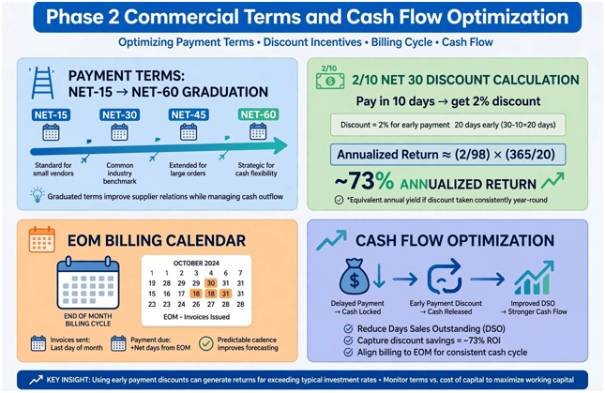
When cash is tight, extended terms protect your bank balance. When building new supplier relationships, I use a graduation model: I start on 15-day terms, make every payment early for six months, and then request Net-45 or Net-60 terms.
I also calculate the annualized return on trade credit discounts. A standard “2/10 Net 30” invoice—offering a 2% discount if paid within 10 days—yields an annualized return of roughly 73%. If liquidity permits, take the discount; if cash is tight, use the 30-day window to preserve reserves. Pair these approaches with End-of-Month (EOM) invoicing so the net-payment clock starts on the last day of the billing cycle.
| Payment Term Model | Mechanism | Cash Flow Benefit |
| Graduation Net Terms | Move from Net-15 to Net-45 after 6 months of on-time payments | Expands working capital as trade history matures |
| Early Payment Discount (2/10) | Deduct 2% if paid within 10 days; full balance at 30 days | Yields ~73% annualized savings on inventory |
| End-of-Month (EOM) Billing | Term clock begins on the final calendar day of billing month | Up to 25 extra days of interest-free float |
| Price Escalation Caps | Hard cap on annual price increases (e.g., max 3–5%) | Prevents unbudgeted cost surges |
Phase 3: Operational Logistics and SLA Protection

Operational friction can quickly wipe out discounts. A shipment delayed by three days can leave store shelves empty during high-traffic weekends.
Your contract must include precise Service Level Agreements (SLAs). I specify explicit delivery windows, acceptable receiving hours, and handling rules for temperature-sensitive inventory. Integrating inventory shrinkage prevention protocols into your receiving workflow ensures staff catch damage or missing items before signing the delivery receipt.
Review guidance from the Federal Trade Commission regarding commercial delivery obligations and merchant rights to ensure vendor terms comply with fair commercial trade standards.
| Operational Clause | Specification Requirement | Financial Consequence |
| Service Level Agreement | 98% on-time delivery rate within 2-hour drop window | Automatic 5% invoice credit per missed delivery |
| Off-Peak MOQs | 40% reduction in order minimums during off-peak seasons | Prevents dead capital in slow months |
| Freight & Damage Liability | FOB Destination; supplier owns transit and damage risk | Eliminates unexpected charges for damaged goods |
Phase 4: Risk Mitigation and Contract Guardrails

Never rely on verbal handshake commitments made by a sales representative. If a vendor promises free shipping on rush orders, write that provision directly into the master agreement.
Protect your business by adding mutual non-disclosure clauses to keep your volume data, pricing, and customer details confidential. For formal legal templates, the U.S. Small Business Administration provides procurement frameworks that help local operators set up binding terms.
Include voluntary exit provisions that let you terminate the contract with 30 days’ notice if the vendor repeatedly fails to meet agreed SLAs. Cap deconversion or file-transfer fees so a departing vendor cannot hold your account records hostage.
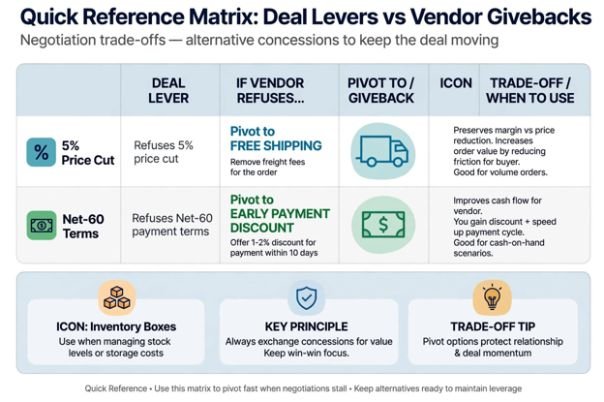
Quick Reference Matrix: Deal Levers vs. Vendor Givebacks
Never concede on a contract point without asking for something in return. If a supplier refuses to lower their base price, use secondary levers to reduce your total cost of ownership.
| If the Vendor Refuses This: | Pivot Your Demand to This: | Measurable Business Benefit |
| 5% Unit Price Cut | Free shipping on standard orders | Eliminates variable freight surcharges |
| Net-60 Payment Terms | 3/10 Net 30 early payment discount | Secures a reliable cash discount |
| Lower Minimum Order Quantity | Consignment stock on specialty items | Protects cash flow on slow-moving inventory |
| Eliminating Restocking Fees | Extended 60-day return window on unsold stock | Lowers the risk of obsolete inventory |
Frequently Asked Questions
1. When should a business owner walk away from a vendor negotiation?
Walk away when the supplier rejects core quality baselines or refuses to define financial liability for damaged inventory.
2. What is the ideal payment term to negotiate with a new supplier?
Target Net-30 terms, but accept Net-15 with an agreed review at 90 days to graduate to longer terms.
3. How can small operators get volume pricing with modest purchasing power?
Consolidate orders into predictable monthly drops or collaborate with non-competing local businesses to place bulk pool orders.
4. What is the most overlooked hidden cost in vendor contracts?
Variable freight fees, including fuel surcharges, liftgate fees, and recurring split-shipment administration costs.
Stop Paying Retail for Wholesale Trust
A vendor partnership is a balance sheet asset, not a personal friendship. When you treat trade negotiations as a structured process, suppliers respect your business, prioritize your deliveries, and protect your margins. Pull out your current top three supplier invoices today, mark every line-item charge that is not base product, and use this checklist to run your next quarterly supplier review.
Leave a Reply