
Frontline teams operate under relentless customer pressure, unpredictable shift patterns, and broken point-of-sale terminals. When I audited our field operations two years ago, our retail eNPS hovered at -18. Corporate assumed staff wanted free pizza and branded water bottles. In reality, our cashiers spent forty minutes every shift wrestling with barcode scanners that lost battery power by noon.
Learning how to improve frontline employee net promoter score does not require sweeping organizational overhauls. It requires systematically removing the small daily friction points that drain morale on the floor.
Frontline turnover costs US businesses billions annually according to data from the U.S. Bureau of Labor Statistics. Deskless workers evaluate their workplace based on whether their physical tools function and whether shift leads listen. Turning detractors into promoters starts with treating field feedback as an operational diagnostic tool rather than a passive HR metric.
Fix the Deskless Feedback Architecture First

You cannot solve problems if your data collection model irritates the workforce. Forcing a retail associate or nurse to finish a twenty-minute survey during a fifteen-minute rest break creates immediate resentment.
Keep Pulses Under 90 Seconds
Deskless employees do not sit at laptops checking corporate email. In my operational rollouts, response rates jumped from 14% to 81% simply by moving surveys to mobile QR codes placed in breakrooms.
Limit every check-in to three elements:
- The standard 0–10 score.
- A single open field for physical bottlenecks.
- Shift-level segmentation tags.
Third-party survey tools protect associate identities. When staff trust that their shift lead cannot trace critical remarks back to them, their honesty exposes genuine operational failures. Pair this data collection with a predictable communication cadence for distributed frontline teams so employees know exactly when leadership reviews their submissions.
Decouple Store Manager Bonuses from Raw Scores
Tying regional or store manager compensation to raw eNPS ruins data integrity. Gallup research on frontline management repeatedly demonstrates that direct supervisors make or break the employee experience. However, when managers face penalties for low scores, they coerce staff or plead for favorable ratings.
Evaluate managers on action plan completion rates instead. If a manager identifies three breakroom problems and resolves two within thirty days, reward that operational response. Rewarding transparency surfaces problems early, whereas penalizing low numbers hides them until top performers quit.
Bridge the Shift Floor and Headquarters

Frontline cynicism sets in when corporate sends surveys, reviews the data behind closed doors, and changes nothing. Bain & Company’s Net Promoter framework insists on closed-loop feedback systems for a reason: employees must see the tangible result of their feedback.
Close the Operational Quick-Win Loop
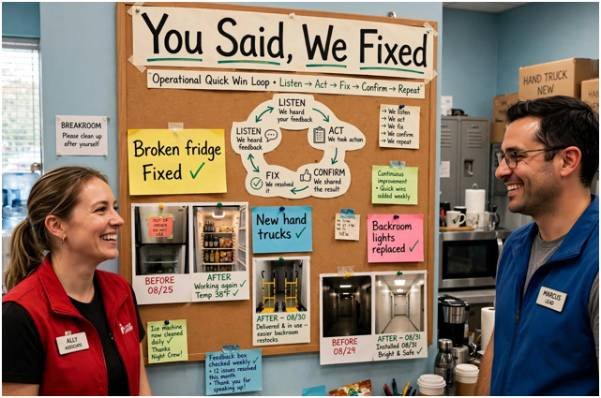
I categorize frontline survey responses into two buckets: structural challenges and physical quick wins. Structural issues—like hourly wage structures or healthcare benefits—require quarterly financial reviews. Physical quick wins require forty-eight hours.
When workers complain about broken breakroom refrigerators, missing hand trucks, or flickering backroom lights, fund those repairs instantly. Post a visual “You Said, We Fixed” board in the breakroom displaying resolved complaints. Visible responsiveness proves to your team that their words drive immediate capital allocation.
Normalize Upward Mobility and Peer Recognition
Frontline work becomes demoralizing when workers view their position as a dead end. Harvard Business Review notes that worker retention stabilizes when deskless staff see clear skill-acquisition milestones. Map hourly roles directly to supervisor tracks with public, objective criteria.
Equally vital is team dynamics. Managers must actively handle peer conflict among frontline workers before interpersonal friction poisons the shift culture. Pair peer-to-peer recognition programs with manager praise to reinforce everyday excellence without incurring massive administrative overhead.
Frontline Friction Points vs. High-Impact Interventions
The table below outlines common root causes of frontline detractor scores and field-tested solutions:
| Common Friction Point | Why It Drives Detractor Scores | High-Impact Operational Fix |
| Faulty Hardware & Systems | Wastes worker time and triggers angry customer interactions. | Create a fast-track budget specifically for local equipment maintenance and replacements. |
| Opaque Shift Scheduling | Last-minute shifts disrupt child care, transit, and sleep patterns. | Publish schedules 14 days in advance; deploy self-serve digital shift-swapping. |
| Absent Corporate Leadership | Staff feel like invisible cogs whose daily challenges are dismissed. | Mandate quarterly floor-shadow shifts for all corporate directors and executives. |
| Unaddressed Interpersonal Drama | Toxic shift leads go unchecked due to aggregate reporting. | Filter eNPS data by shift, store department, and direct supervisor. |
| No Growth Visibility | High performers leave for a $0.50 raise elsewhere due to stagnation. | Publish objective micro-credential pathways tied to predictable pay tiers. |
Stop Measuring Without Fixing
Tracking an employee score without dedicating budget to resolve complaints accelerates burnout. Do not launch your next survey until your operations team commits to resolving localized pain points within thirty days of collection.
Pick two stores next week, run a 90-second mobile pulse, and fund the top three physical requests immediately. Your frontline team will notice the action long before they care about your corporate roadmap.
Frequently Asked Questions
1. What is a good frontline employee net promoter score?
A score between +10 and +30 is solid for deskless teams, while anything above +40 reflects world-class retention.
2. How often should companies measure frontline eNPS?
Run concise, 90-second pulses every 60 to 90 days to track trends without creating survey fatigue.
3. What is the primary cause of low frontline employee scores?
Failing to fix daily equipment bottlenecks while ignoring worker feedback causes the steepest score drops.
4. Can eNPS accurately predict frontline staff turnover?
Yes, sustained declines in promoter percentages typically foreshadow elevated retail and hospitality turnover within two quarters.
Leave a Reply