
A single key employee calling in sick can bring a lean enterprise to a complete halt. I learned this the hard way when our sole billing specialist took medical leave, stalling our accounts receivable for three straight weeks. Designing a cross training employees benefit matrix for small business operations became our survival mechanism. By mapping capabilities against operational vulnerabilities, small teams build resilience without inflating payroll costs.
The Single-Point Failure Trap in Lean Teams
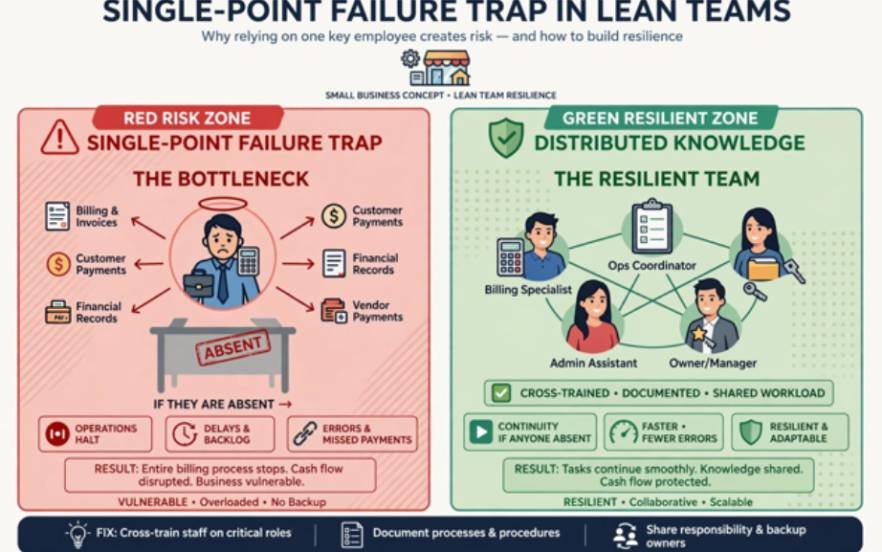
Running a business with five to twenty employees often creates accidental knowledge silos. When only one team member knows how to generate shipping labels or run client onboarding, that person becomes a structural bottleneck. Conducting an operational efficiency audit reveals these hidden vulnerabilities before an emergency forces your hand.
According to workforce continuity research by the U.S. Small Business Administration, operational redundancies separate agile small firms from those that shutter during localized disruptions. Cross-training distributes specialized know-how across functional teams, converting fragile dependencies into interchangeable capabilities.
Mapping Core Functions to High-Yield Outcomes
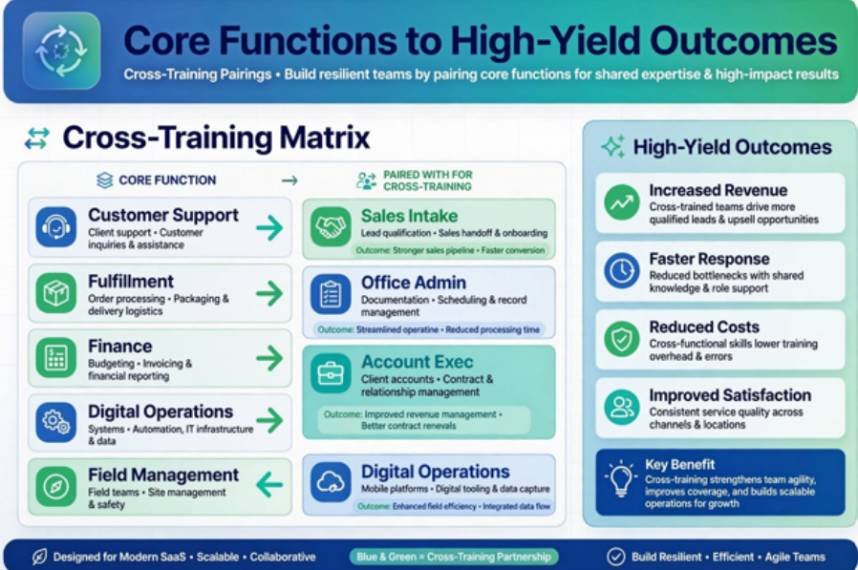
Cross-training creates measurable business upside across daily operational tracks. The table below illustrates how pairing specific roles protects bottom-line continuity.
| Core Business Function | Cross-Trained Role Pair | Target Competency / Task | Direct Business Benefit |
| Customer Support | Support Rep ➔ Sales Intake | CRM lead qualification & logging | Zero missed leads during call spikes |
| Fulfillment | Office Admin ➔ Shipping/Inventory | Label generation & stock counts | Order continuity during peak volume |
| Finance & Admin | Account Exec ➔ Invoicing Basics | Creating invoices & Net-30 follow-up | Steady cash flow during bookkeeper leave |
| Digital Operations | Social Lead ➔ Basic CMS Updates | Content publishing & minor copy edits | Eliminates costly agency retainers |
| Field Management | Shift Lead ➔ Payroll Verification | Timecard audits & daily checklists | Protects owner bandwidth for growth |
Cross-skilling frontline staff also helps reduce absenteeism in shift work operations by giving workers variety and coverage flexibility when emergencies arise.
The Strategic Skills Matrix: Levels 0 Through 3
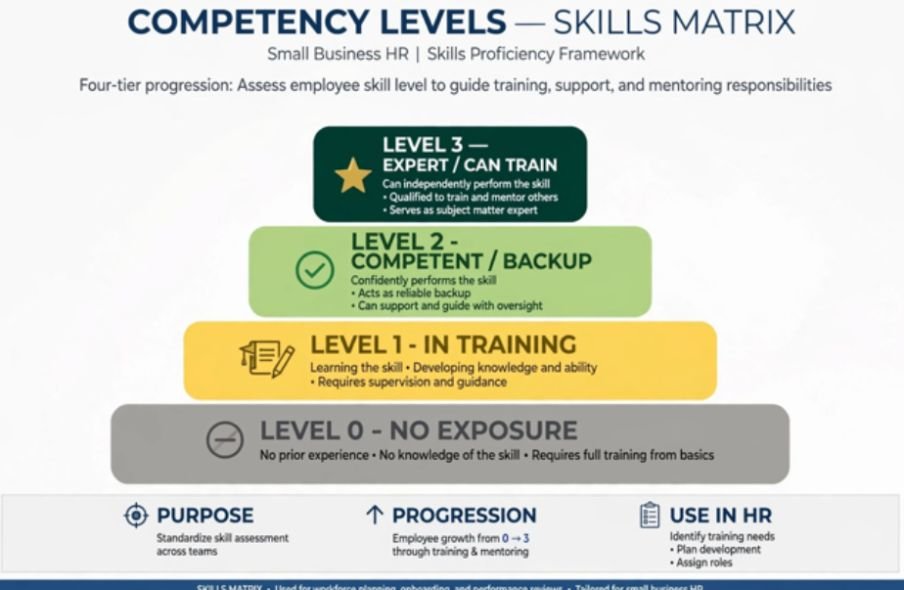
A benefit matrix works only when paired with an honest assessment of current staff capabilities. I use a four-tier tracking grid to monitor team coverage across mission-critical duties.
Competency Levels:
[Level 3: Expert / Can Train] ➔ Fully autonomous; mentors others
[Level 2: Competent Backup] ➔ Executes reliably during absence
[Level 1: In Training] ➔ Understands basics; requires guidance
[Level 0: No Exposure] ➔ Unassigned; zero system access
Data from the Society for Human Resource Management indicates that organizations mapping multi-role proficiencies experience significantly lower turnover. Tracking proficiencies visibly helps managers deploy talent strategically.
Competency Tiers That Prevent Operational Chaos
Evaluating employees using this framework highlights single-operator risks immediately.
| Employee Name | Task A: Billing Run | Task B: Site Maintenance | Task C: Inventory Intake |
| Marcus Vance | Level 3 (Primary) | Level 0 | Level 2 (Backup) |
| Elena Rostova | Level 2 (Backup) | Level 3 (Primary) | Level 0 |
| David Chen | Level 1 (Trainee) | Level 0 | Level 3 (Primary) |
If Marcus takes unexpected leave, Elena steps in seamlessly at Level 2 competency. Cash flow continues uninterrupted.
The 90-Day Rollout Playbook for Lean Operations
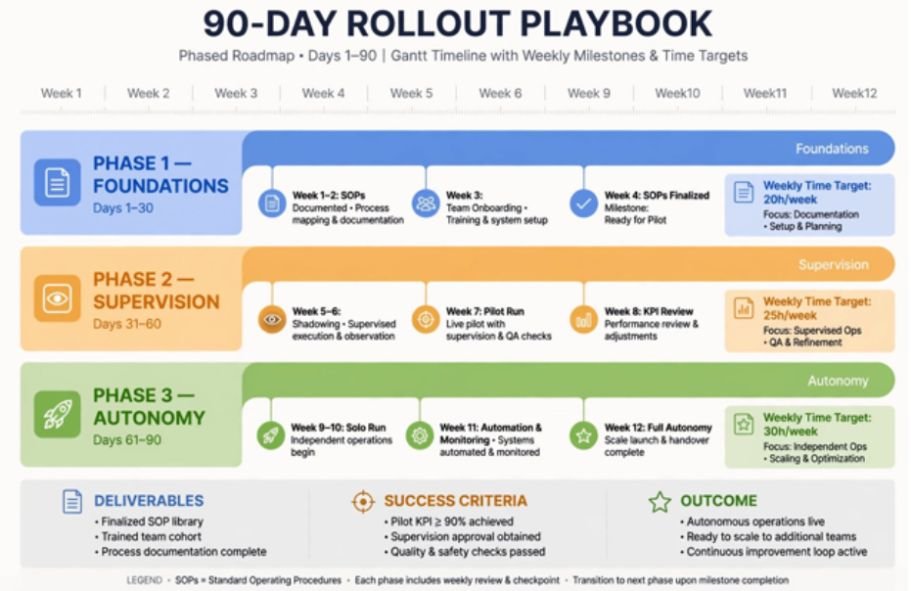
| Phase | Window | Weekly Time Target | Tangible Milestone Output |
| Phase 1: Foundations | Days 1–30 | 1–2 hours / week | Validated 1-page SOPs & 1-on-1 capacity buy-in |
| Phase 2: Supervision | Days 31–60 | 2–3 hours / week | Completed shadowing & verified software logins |
| Phase 3: Autonomy | Days 61–90 | 1–2 hours / week | First solo production run & maintenance cadence |
Rolling out cross-skilling without a phased schedule overwhelms daily operational capacity. I rely on a structured 90-day cycle to introduce new proficiencies gradually.
Understanding the impact of predictable scheduling on overall workplace productivity can also help managers create consistent training windows without disrupting daily operations.
Peer-reviewed analysis published in the Harvard Business Review highlights that cross-functional development improves retention when businesses provide designated learning windows during normal working hours.
Mitigating Skill Dilution and Staff Resentment
Cross-skilling initiatives fail when leadership ignores human factors. Two primary friction points require proactive mitigation:
- Compensation Friction: Workers often interpret cross-training as unpaid workload inflation. Anchor cross-training to professional growth paths, skill-tier bonuses, or merit reviews. Workplace research by Gallup links internal upskilling directly to increased employee engagement when paired with recognition.
- Skill Atrophy: A backup who handles a task once a year forgets the steps. Schedule recurring half-day rotations every month so backup operators maintain active operational memory.
Frequently Asked Questions
1. How does a skills matrix differ from a job description?
A job description lists hiring requirements, whereas a skills matrix tracks dynamic real-time capabilities across a functioning team.
2. How many backup operators should a small business train per task?
Every mission-critical operational task requires at least one Level 2 backup operator alongside the primary owner.
3. What is the best way to prevent employee burnout during cross-training?
Cap weekly training hours at 10% of total working time and schedule sessions during historical low-volume periods.
4. Can small businesses run cross-training without enterprise HR software?
A cloud-hosted spreadsheet tracking standard Level 0 through Level 3 metrics provides sufficient functional visibility.
Stop Running on Operational Thin Ice
Building operational redundancy is not an expensive luxury reserved for large enterprises. Run a quick capability audit across your primary processes this week, pinpoint your solo dependencies, and assign your first Level 1 cross-training pair.
Leave a Reply