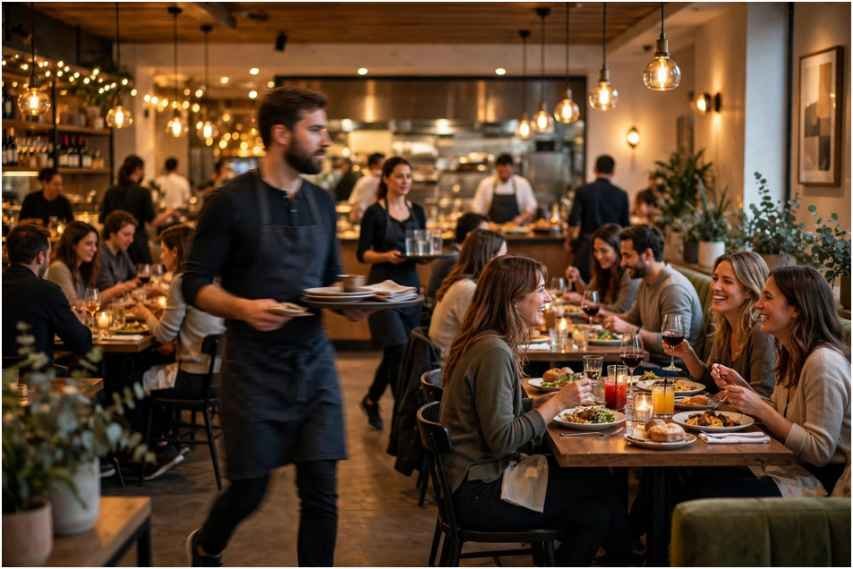
When I ran shift operations in a busy 80-seat bistro, our team spent months believing that faster turns required pushing guests out the door. We were wrong. Rushing diners kills check averages, destroys hospitality, and ruins gratuities. True restaurant table turnover rate optimization strategies focus on eliminating administrative latency—the dead time spent waiting for orders, checks, and resets.
By restructuring our service sequence to target unforced operational delays, we shaved twelve minutes off our average ticket time. That single shift transformed our bottom line without a single guest feeling hurried.
The Economics of Eliminating Friction Over Speed
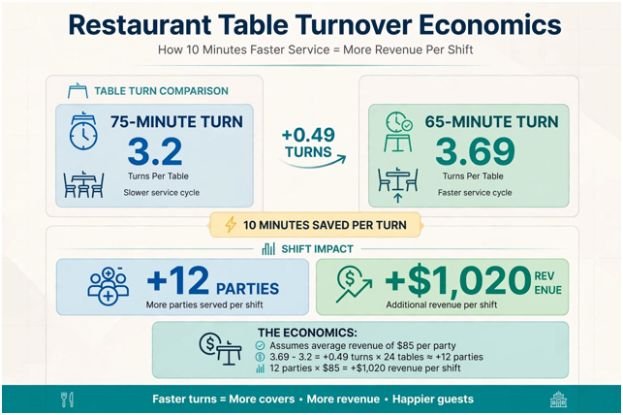
Table turnover measures how many distinct parties occupy a single table over a meal period. When tables sit idle between guests or diners wait endlessly for payment terminals, your floor bleeds margin.
Turnover Rate = Shift Length (Minutes) / Average Turn Time (Minutes)
If you operate a 4-hour dinner shift (240 minutes) with an average dining duration of 75 minutes, each table yields 3.2 turns. Reducing that duration to 65 minutes increases your yield to 3.69 turns. That small fraction translates to serious money when applied across a full dining room.
| Metric | Baseline (75-Minute Turns) | Optimized (65-Minute Turns) | Operational Gain |
| Turns Per Table | 3.20 | 3.69 | +0.49 turns |
| Parties (25 Tables) | 80 parties | 92 parties | +12 parties / shift |
| Shift Revenue ($85 Avg Check) | $6,800 | $7,820 | +$1,020 / shift |
| Annual Delta (6 Shifts/Week) | $2,121,600 | $2,439,840 | +$318,240 / year |
These gains work in tandem with long-term strategies to lower operating costs in restaurant business to dramatically widen operational profit margins.
Auditing the Meal Lifecycle for Dead Time
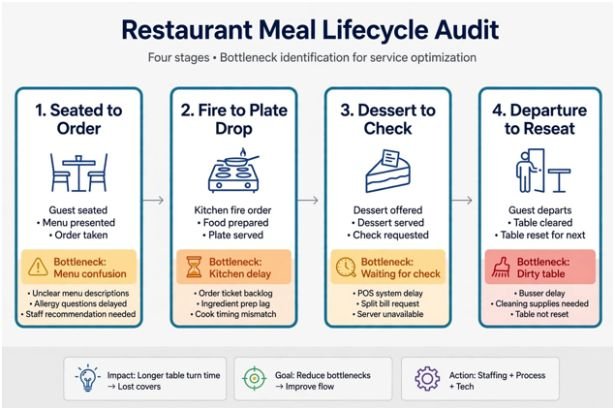
Every meal consists of dining time (eating, conversing, relaxing) and dead time (waiting). Research published by the Cornell Center for Hospitality Research highlights that guest satisfaction correlates with pacing consistency rather than raw speed.
I audit four service stages to isolate hidden waste:
| Service Stage | Common Bottleneck | Corrective Operational Action |
| Seated to Order | Analysis paralysis over sprawling menus | Train servers to deliver beverage service and take orders within 90 seconds. |
| Fire to Plate Drop | Kitchen line imbalances during peak hours | Balance line-cook ticket distribution with standardized prep routines. |
| Dessert to Check | Waiting for dropped bill, pickup, card swipe | Settle payments tableside instantly via digital terminals. |
| Departure to Reseat | Dirty tables lingering unattended | Assign dedicated busser runners during peak reservation waves. |
Front-of-House Workflows That Protect Hospitality
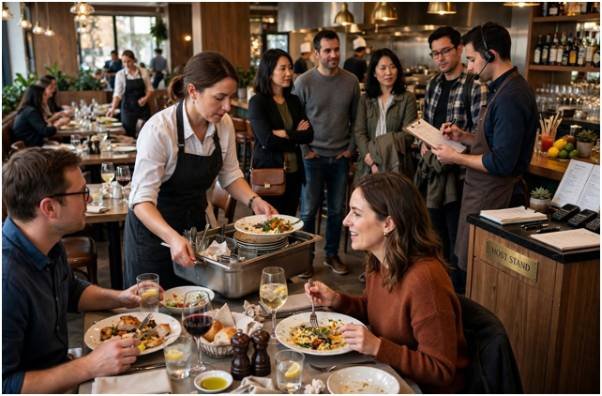
Floor efficiency relies on clear guardrails. Without defined standards, servers default to disorganized habits that bottleneck the dining room.
Complete Parties and Continuous Pre-Busing
Never seat partial parties during high-demand rushes. One guest waiting 25 minutes for friends occupies a table that could complete half a dining cycle. Establish a polite, firm check-in protocol at the host stand to stage parties near the bar until everyone arrives.
Simultaneously, enforce systematic pre-busing. Servers must clear dirty plates, discarded glassware, and wrappers continuously throughout the meal. By the time a dessert fork drops, the table should hold only water glasses and the check presenter. This practice cuts bussing and sanitization time from five minutes down to ninety seconds.
Maintaining these demanding workflows requires adequate floor coverage. Review our fair workweek compliance checklist to schedule support staff predictably without incurring costly overtime penalties.
Floor Architecture and Menu Engineering
A dining room’s physical setup dictates how fast it operates. If your servers weave through crowded choke points to grab clean forks, you lose valuable minutes on every turn.
Dynamic 2-Top Seating Over Rigid Layouts
Industry data from the National Restaurant Association shows that party sizes of two make up the largest dining demographic in casual and upscale-casual concepts. Yet many dining rooms rely on fixed four-top tables.
| Table Configuration | Seating Efficiency | Capacity Utilization | Impact on Flow |
| Fixed 4-Top Booths | Low for 2-person parties | 50% seat loss per couple | Restricts flexibility during evening rushes |
| Modular 2-Tops | High across all party sizes | 90–95% optimal seating | Easily pushed together or separated on demand |
| Communal Seating | Very High | 95%+ high-density seating | Ideal for walk-ins, solo diners, and fast turnaround |
Splitting rigid booths into modular two-top tables lets your hosts assemble custom layouts on the fly. You instantly eliminate the dead capacity of two guests occupying a four-top.
Pair your floor design with a focused, engineered menu. Large menus overwhelm guests and slow the kitchen. Cutting your menu by 20% simplifies line prep, speeds customer decisions, and eliminates slow-moving inventory.
Tech Integrations That Shave Minutes
Mobile hardware and automated booking platforms remove administrative steps from service. A study by Deloitte Consumer Hospitality Insights found that restaurants utilizing modern digital ordering and payment tools reduced table occupancy duration by up to 30%.
Equipping front-of-house teams with handheld terminals, as highlighted in the Toast Restaurant Technology Report, allows servers to send drink orders directly to the service bar while standing at the table. Food items fire to the kitchen line immediately, bypassing the wait at stationary terminal banks. Most importantly, servers close out tabs at the table in thirty seconds.
Stop Rushing Diners and Start Orchestrating Flow
Maximizing your turnover rate is about managing floor logistics, not forcing guests to eat faster. When you strip out administrative lag—the bill-dropping dance, slow resets, and sprawling menus—diners enjoy an attentive, seamless meal. Your kitchen stays in rhythm, your servers handle higher volumes with less stress, and your floor generates predictable revenue every single shift.
Start by auditing your payment collection process this weekend; cutting that single bottleneck yields the fastest return in hospitality.
Frequently Asked Questions
1. What is a good table turnover rate for a restaurant?
Casual restaurants typically target 3 to 4 turns per shift, while fine-dining establishments average 1.5 to 2 turns.
2. How do you calculate table turnover rate?
Divide the total number of seated parties during a shift by the total number of available tables.
3. Will turning tables faster hurt guest tips?
No, eliminating payment delays and service gaps improves guest satisfaction while allowing staff to serve more total parties.
4. How do I move lingering guests without being rude?
Politely invite them to the bar and offer a complimentary after-dinner drink to free up high-demand tables.
Leave a Reply